TNT Audio

Professional Mobile Electronics Since 1997

4803 N Navarro, Victoria, Texas 77904 361-576-6117
  • Home
  • Services
    • Car Audio
    • Custom Installation
    • Marine Audio
    • Vehicle Security
  • About Us
  • Location
  • Contact Us

Product Spotlight: Audison APBX 10 AS2

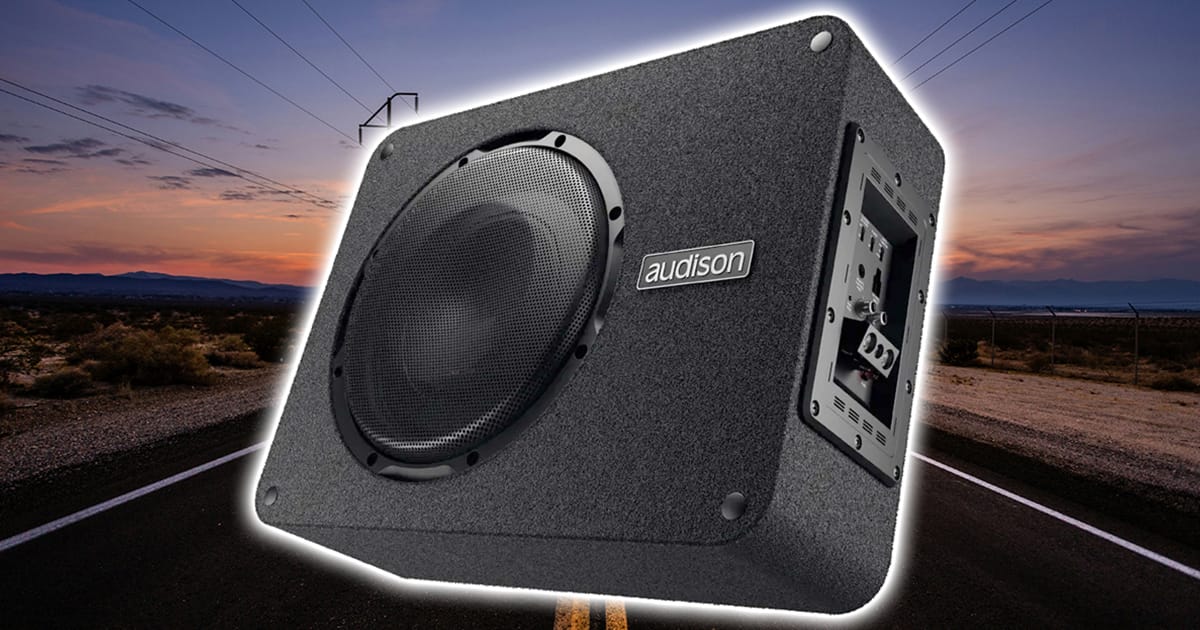
Audison APBX 10 AS2

One of the best upgrades you can make to your car audio system is to add a high-quality subwoofer. Whether you are working with a simple factory-installed radio and speaker system or planning a studio-quality listening environment, accurately reproducing bass frequencies is important. The folks at Audison have a full line of compact subwoofer enclosures that can transform your system from good to awesome. In this spotlight, we will look at the Audison APBX 10 AS2.

Features of the Audison APBX 10 AS2

The APBX 10 AS2 is a low-profile 10-inch active subwoofer enclosure. The term “active” means this unit has an integrated amplifier. Essentially, with some wiring to feed it power and a signal from the radio, this is all you need to add bass to your car, truck, or SUV.

The enclosure measures 17.3 inches long, 13.2 inches wide, and stands a mere 6.2 inches tall. The amplifier is mounted on one of the thin side panels, and the subwoofer is designed to fire down into the floor or back wall of your car or truck. Feet are included to raise the enclosure off the floor so the subwoofer doesn’t hit anything. The enclosure has rounded corners for a little extra style.

The amplifier included with the APBX 10 AS2 is rated to provide up to 400 watts of power. Audison uses a 0.16-ohm low-impedance driver in the enclosure, so the amp doesn’t need a switching power supply. This design is said to boost system efficiency.
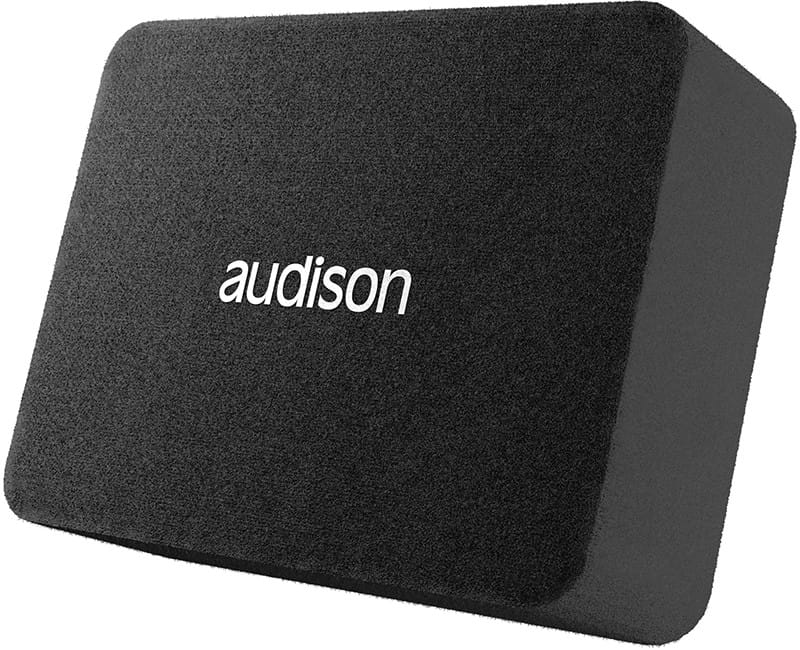
Audison APBX 10 AS2
The Audison APBX 10 AS2 looks neat and tidy once installed.

Amplifier and Integration Features

The amplifier can accept speaker-level or preamp signals to ensure integration with factory-installed and aftermarket source units is simple and reliable. In high-level mode, the amp will accept up to 8 Vrms on the speaker leads. In low-level mode, the maximum input is 4 Vrms.

The amp has a three-position remote turn-on function switch. The amp can be activated when 12 Volts is applied to the remote terminal. Alternatively, in DC mode, the amp’s circuitry will monitor the speaker wires for the DC offset voltage from a BTL amplifier. Finally, if neither of those options works with your source unit, the amp can detect an electrical audio signal to bring things to life.

In terms of signal processing, the amp has a crossover that can be adjusted from 50 to 300 hertz and features a second-order Butterworth alignment. The internal crossover can be defeated with the Lo-Pass/By-Pass switch if you have a source unit or signal processor with integrated filtering. There is also a bass boost function that lets your installer dial in a bump of up to 6 dB at 45 Hz to add a little extra thump to your music. Finally, there’s a fixed fourth-order (-24 dB/Octave) infrasonic filter set to 24 Hz.
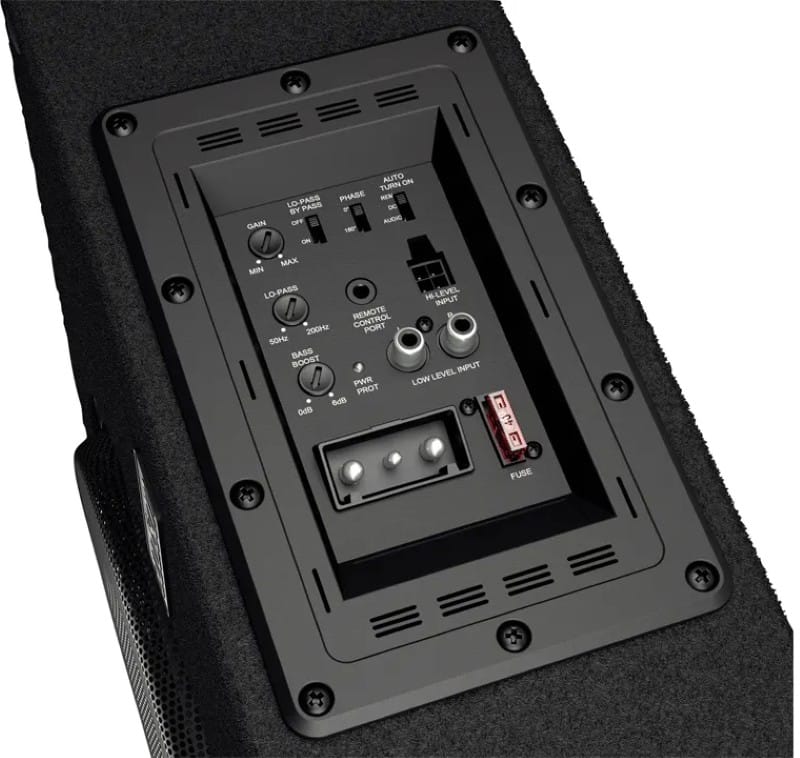
Audison APBX 10 AS2
All connections to the amp can be remoted without tools in the event you need to free up some cargo space.

Audison includes their HRC AP remote level control with the APBX 10 AS2. This remote connects to the amp via the included 3.5mm jack. Your installer can mount the control on the dashboard or in the center console to give you control over the bass level. While the original gain setting should provide a nice balance, sometimes we want a little more or a little less bass, depending on our mood or the choice of music.

The amplifier includes a feature called Dynamic Bass Tracking (DBT). This circuitry monitors the audio input in real time to prevent signals that could cause distortion, keeping your music from sounding bad. This circuit will also prevent damage to the woofer.
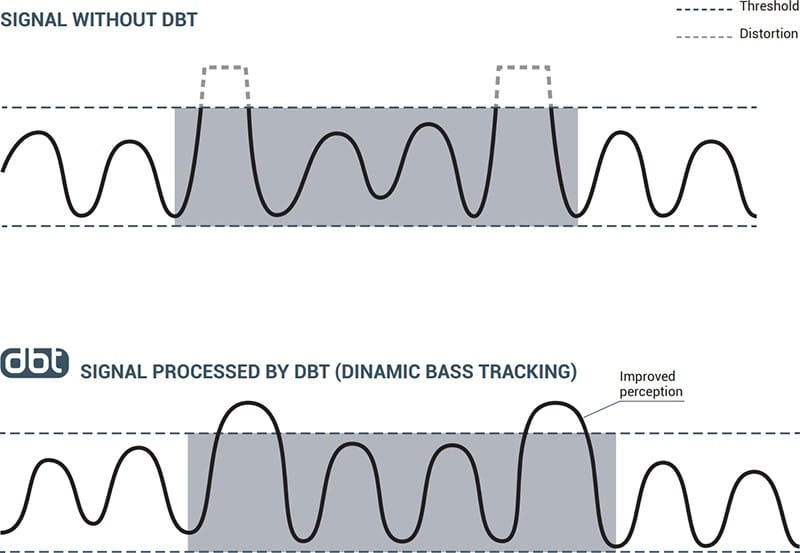
Audison APBX 10 AS2
The Dynamic Bass Tracking built into the APBX 10 AS2 helps to prevent high-level transients from adding significant amounts of distortion.

Audison Subwoofer Features

The subwoofer integrated into the enclosure is based on Audison’s APS 10 series of drivers. The subwoofer features a heavy-gauge stamped-steel chassis to which a single ferrite magnet is affixed. Cooling vents in the basket, under the spider mounting plateau, help to keep the voice coil assembly cool. There are also vents in the cone to allow hot air to escape from the motor assembly.

The cone is made of pressed paper with a water-repellent coating to prevent it from absorbing moisture in humid or damp climates. A polypropylene dust cap keeps debris out of the magnetic gap and gives the driver’s face a clean, classy appearance.

Upgrade Your Car Audio System with Audison Today!

If you want to take your car audio system to the next level, drop by an authorized Audison retailer today and ask about the APBX 10 AS2 subwoofer enclosure. Audison offers a similarly designed, but slightly more compact 8-inch solution called the APBS 8 AS2 if space is at a premium.

You can find an authorized retailer using the locator tool on the Audison website. Be sure to follow Audison on Facebook, Instagram, and YouTube to learn about all the amazing audio integration solutions they offer.

This article is written and produced by the team at www.BestCarAudio.com. Reproduction or use of any kind is prohibited without the express written permission of 1sixty8 media.


Filed Under: ARTICLES, Car Audio, Products, RESOURCE LIBRARY Tagged With: Audison

Understanding the Basics of Digital Audio Files

Digital Audio

If you are in your late 40s or older, then you likely grew up with a turntable or tape player in your home as a way of listening to store-bought music. Between 1982 and 1983, the compact disc entered the market and forever changed the way music was stored and transported. In this article, we are going to look at how digital audio works and dispel some of the myths around the conversion between the analog and digital domains.

What Is Digital Audio?

Digital Audio

In the simplest of terms, a digital audio file is a representation of an analog signal using a series of digital words. In the digital domain, i.e., a computer, information can be stored as a 1 or a 0.

Computers can combine strings of 1s and 0s to represent characters in a text document, colors in a photograph, commands in a program or voltage levels in an audio file.

For decades, the standard for storing audio in the digital domain has been the Red Book Compact Disc Digital Audio (CD-DA) standard of a 44.1kHz sampling rate with a depth of 16 bits.

The sampling rate describes how often a voltage level is measured and stored. To capture the entire audible spectrum of sound, the Nyquist-Shannon sampling theorem states that the sampling rate needs to be at least twice as high as the highest frequency you want to record for it to be recreated with accuracy.

The second consideration in converting an analog signal to the digital domain is the need to store an adequate amount of resolution to properly represent the original signal. The Red Book standard uses a digital word length of 16 bits. This means that there is a string of 16 1’s and 0’s that can be used to represent 65,536 voltage levels. If you are converting the output of a microphone to digital, and the maximum voltage is 1 volt, then a resolution of 16 bits means that the resolution is 0.000015258789 volts. That’s a lot of detail.

Finally, the Red Book standard states that two channels of audio will be sampled simultaneously to create a stereo recording.

Some Quick Math on CD Quality Audio

Digital Audio

For those interested, it’s easy to calculate the effective bitrate of a CD-quality audio file. Since we sample the audio signal at 44,100 times a second, and each sample has a voltage level represented by a 16-bit word, and we do this for two channels, 44,100 times 16 times two is 1,411,200, or 1.411 kilobits per second.

To calculate how much space it would take to store a song like “Bohemian Rhapsody” by Queen, you can simply multiply 1,411,200 by the number of seconds in the song (in this case, 355 seconds) for a total of 500,976,000 bits, or about 60 megabytes of data.

How Are Digital Audio Files Created?

Digital Audio

A device called an analog-to-digital converter (ADC) is responsible for taking the analog signal and converting it into a digitally represented value. These devices are commonplace and are found connected to the microphone in your smartphone or the Bluetooth microphone in your car. They are incredibly compact and, relative to when they were first introduced, inexpensive.

ADC work in several ways, but we’ll describe the basics. Imagine, if you will, a series of comparator switches, each stacked one atop the next and referenced to an ever-increasing voltage. We’ll keep the example simple and say that we have eight switches, each of which is triggered at

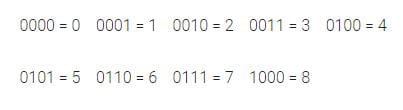
0.125-volt increments. If we feed an analog signal into our comparator switch tree with a level of 0.3 volts, the bottom two switches will turn on, and we get the digital word 0010 (which is 2). If we increase the voltage to 0.8 volts, we trigger all but the last two switches and get the word 0110 (which is 6).

Counting in Digital

Counting in digital is easy, once you understand how it works. Each space in a digital word represents a value of 2 to the power of the location. So, the first space is 2 to the power of 0, which is 1. The second space is 2 to the power of 1, which is 2, the next space is 2 to the power of 2 which is 4, and so on.

codeforarticle2

To encode a value using this format, we simply assign a 1 or a 0 to each placeholder such that the sum values represented by the placeholders with a 1 represent the original value.

codeforearticle3

In our example above, we are using a very low resolution of 3 bits, which means we can show only eight different levels. This limited resolution, of course, introduces some error – known as quantization error. The math can get very complicated very quickly. Suffice it to say that in our example, our theoretical digitizer doesn’t know the difference between a voltage of 0.63 and 0.73 volts. This is a large error and would not work in an attempt to sample audio. Luckily, our 16-bit resolution gives us 65,536 levels from which to choose.

What About Those Crazy Stair-Step Graphs?

You have undoubtedly seen marketing images showing a comparison of CD-quality audio resolution versus high-resolution 96 kHz, 24-bit audio.

Digital Audio
StairStep Graph

While the concept of having a higher sampling rate and more resolution is accurate, it doesn’t mean that the CD-quality audio signal suffers in any way.

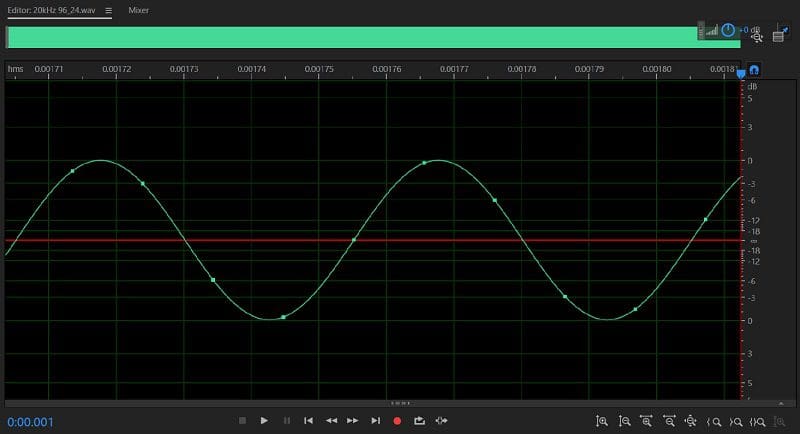
To demonstrate this, we created two 20 kHz test tones in Adobe Audition. The first track has a 96 kHz sampling rate and a resolution of 24 bits.

Digital Audio
20kHz 96-24

As you can see, the waveform looks smooth and detailed and shows roughly five samples per cycle.

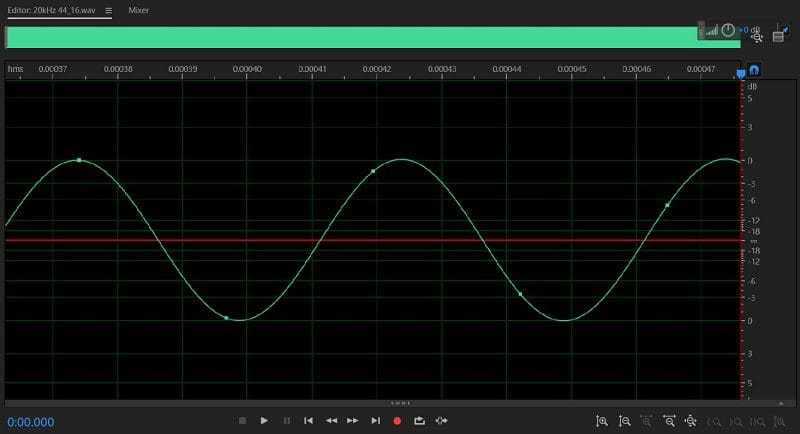
The second track is the same 20 kHz sine wave stored at a sample rate of 44.1 kHz and a resolution of 16 bits.

Digital Audio
Second Track: 20kHz 44-16

As you can see, there is no significant difference in the shape of the two waveforms. More importantly, they both look like sine waves and neither has any stepping in them.

Understanding Digital Audio

Storing audio signal in the digital domain offers distinct packaging and reliability benefits over analog storage media like vinyl records and magnetic tapes. Of course, digital files don’t degrade over time. Digital files are also impervious to playback speed issues. If your turntable or cassette deck is playing too slowly, the music won’t sound right.

In a future article, we’ll look at the file format options available for storing digital audio files. Until then, be sure to drop by your local specialist mobile enhancement retailer to see all the latest digital media-compatible source unit upgrades available for your car, truck or SUV.

This article is written and produced by the team at www.BestCarAudio.com. Reproduction or use of any kind is prohibited without the express written permission of 1sixty8 media.

Filed Under: ARTICLES, Car Audio, RESOURCE LIBRARY

Product Spotlight: Memphis Audio Power Reference Subwoofers

Memphis Audio Power Reference Subwoofers

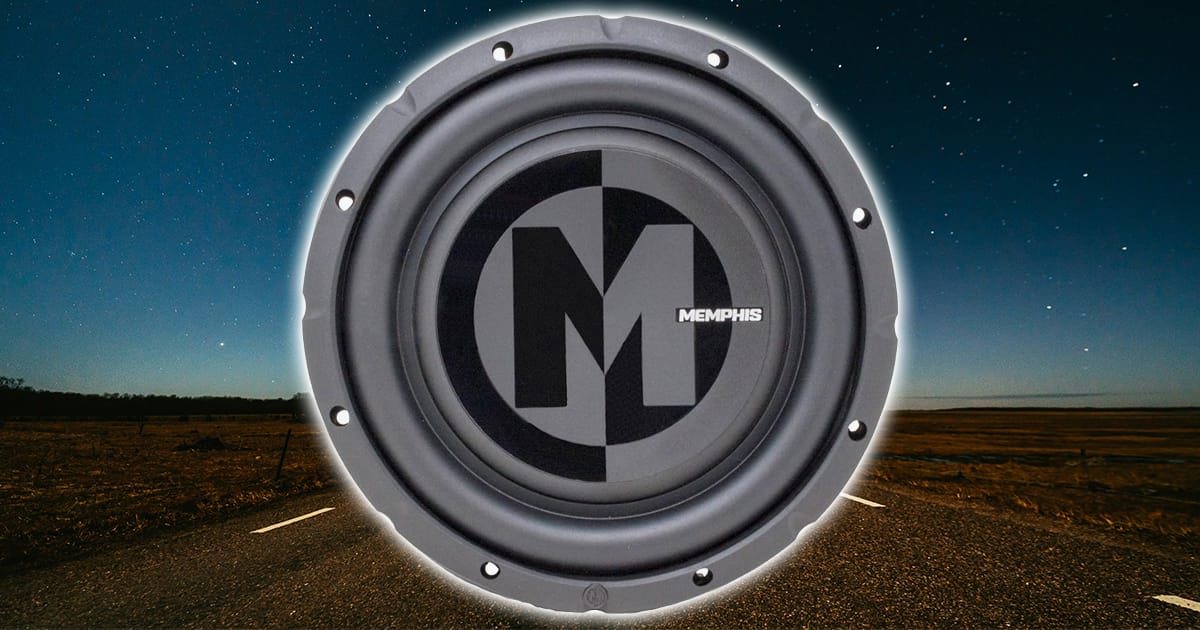
There are hundreds of subwoofer options on the market. For a company to set itself apart from the competition is no easy feat. With that said, Memphis Audio has developed something truly unique that offers value to both retailers and consumers. Let’s take a look at the Memphis Power Reference Series of subwoofers.

Models and Power Handling

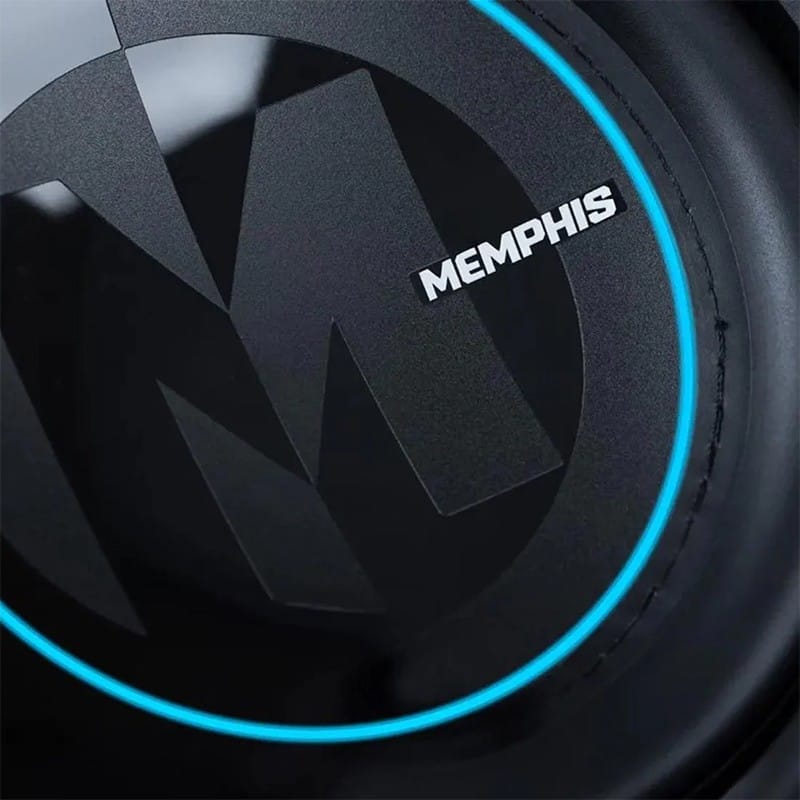
There are six models in the Power Reference series. At the top is the 12-inch PRX12FT, which is rated to handle 400 watts continuously and 800 watts peak. The 10-inch PRX10FT has the same power handling ratings. Both of these drivers are available in models with blue LED illumination built into the cone assembly, as part numbers PRXL12FT and PRXL10FT.

The series includes an 8-inch model called the PRX824V2, which is rated for 200 watts continuous and 400 watts max. Next, there’s the 6.5-inch PRX624, rated for 150 watts continuous and 300 watts max.

The series also includes two shallow-mount woofers. The 12-inch PRXS1224 has a 350-watt continuous, 700-watt max power rating. The 10-inch PRXS1024 has the same ratings.

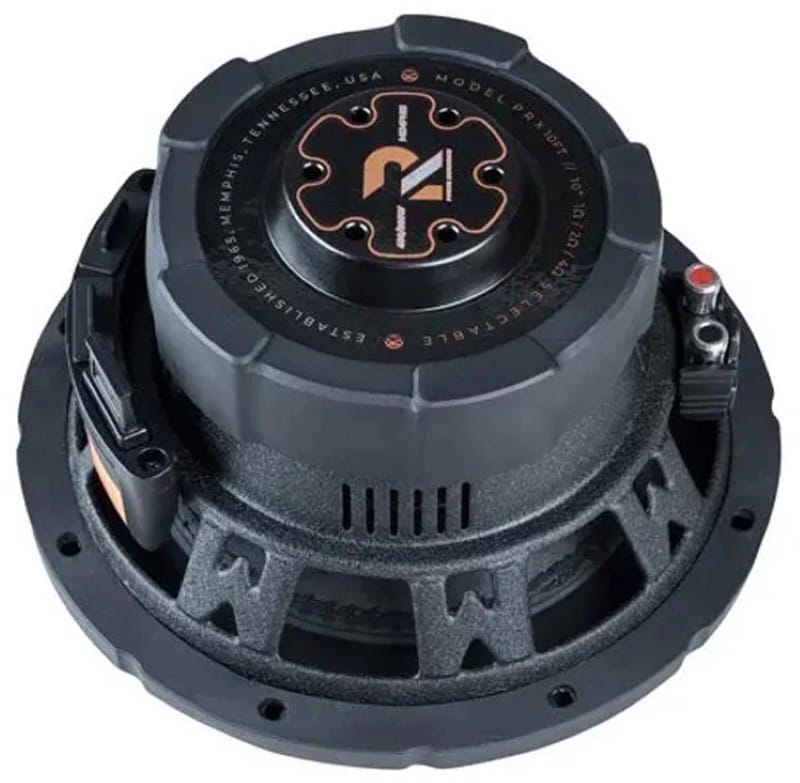
Memphis Audio Power Reference Subwoofers
Memphis offers 10- and 12-inch Power Reference models with integrated blue LED illumination in the cone.

Features of the Power Reference Subwoofers

The Power Reference series includes four sizes: 12-inch, 10-inch, 8-inch, and 6.5-inch models. They are all based on a heavy-gauge stamped-steel chassis that features three thick “M”s on each side, making them unique from all other subs. The drivers feature a polypropylene woofer cone stitched to a rubber surround for reliability. The cone has another giant letter M in two-tone black-on-black artwork. A custom-tooled rubber trim piece serves as a mounting gasket, ensuring an airtight seal against the enclosure face. Memphis sells pressed-mesh grilles compatible with all Power Reference subwoofer sizes.

At the base of the cone is a TIL fiberglass voice coil former to help ensure reliable operation. The tinsel leads are sewn to the spider to ensure quiet operation. Spring-loaded terminals will accept up to 10-AWG speaker wire.

All Power Reference subwoofers feature Direct Voice Coil Cooling (DVCC). DVCC works by including a series of small vents in the bottom plate of the subwoofer. These vents allow hot air to escape from the voice coil. The result is improved power handling and reduced power compression.

Memphis Audio Power Reference Subwoofers
Vents in the voice coil and basket allow hot air to escape from the motor assembly to improve power handling.

FLEX Voice Coil Impedance

If you are used to shopping for subwoofers, then you should have noticed that we listed only a single model in each size. So, what about varying voice coil impedances to optimize the power your amplifier produces? Memphis has developed a system called FLEX Selectable Impedance Technology.

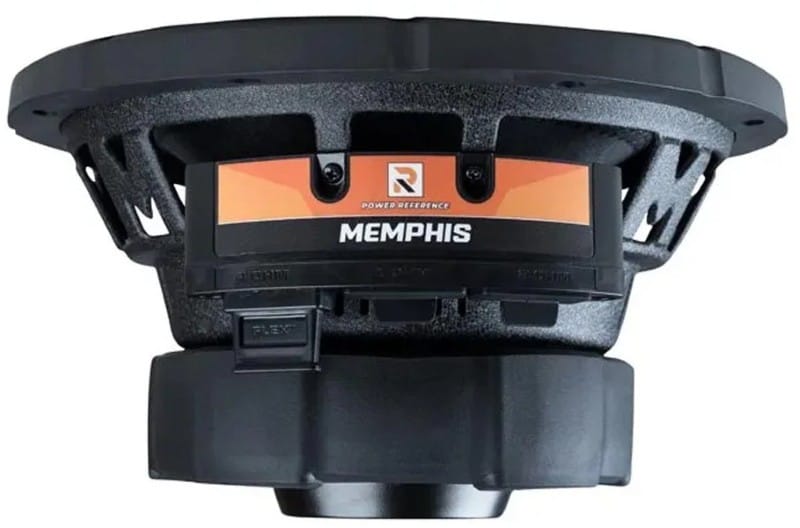
On the 8-inch, 6.5-inch, and shallow-mount subwoofers, there’s a two-position jumper block on the opposite side of the chassis from the speaker terminal block. Depending on where your installer places the jumper, the driver presents a nominal impedance of 4 or 2 ohms. There’s no need to worry about getting the ‘right’ subwoofer for your amplifier. The 10-inch and 12-inch subwoofers feature Tri-FLEX. This solution offers three jumper positions with 1-, 2-, and 4-ohm configurations.

FLEX eliminates the potential confusion associated with series- and parallel-wiring for dual-voice-coil subwoofers and lets your installer get you on the road quickly and efficiently. Very cool!

Memphis Audio Power Reference Subwoofers
The three-position Tri-FLEX jumper allows your installer to choose from 1-, 2-, and 4-ohm configurations.

Check Out Memphis Power Reference Subwoofers Today!

If you are shopping for a high-performance subwoofer solution for your car, truck, or SUV, drop into a local authorized Memphis Audio retailer and ask about the very cool Power Reference subwoofers. You can find a shop near you by using the Locator Tool on the company website. Be sure to follow Memphis Audio on Facebook, Instagram, and YouTube.

This article is written and produced by the team at www.BestCarAudio.com. Reproduction or use of any kind is prohibited without the express written permission of 1sixty8 media.

Filed Under: ARTICLES, Car Audio, Products, RESOURCE LIBRARY Tagged With: Memphis Car Audio

Product Spotlight: KICKER KMC5

KICKER KMC5

Going back a few decades, only a handful of car audio manufacturers offered marine-specific source unit options. These were often car radios with oversized front panels with waterproofing features. Now, there are dozens of companies that offer marine source units. One that stands out for its features and performance is the KICKER KMC5, which is the subject of this product spotlight. Let’s check it out!

Features of the KICKER KMC5

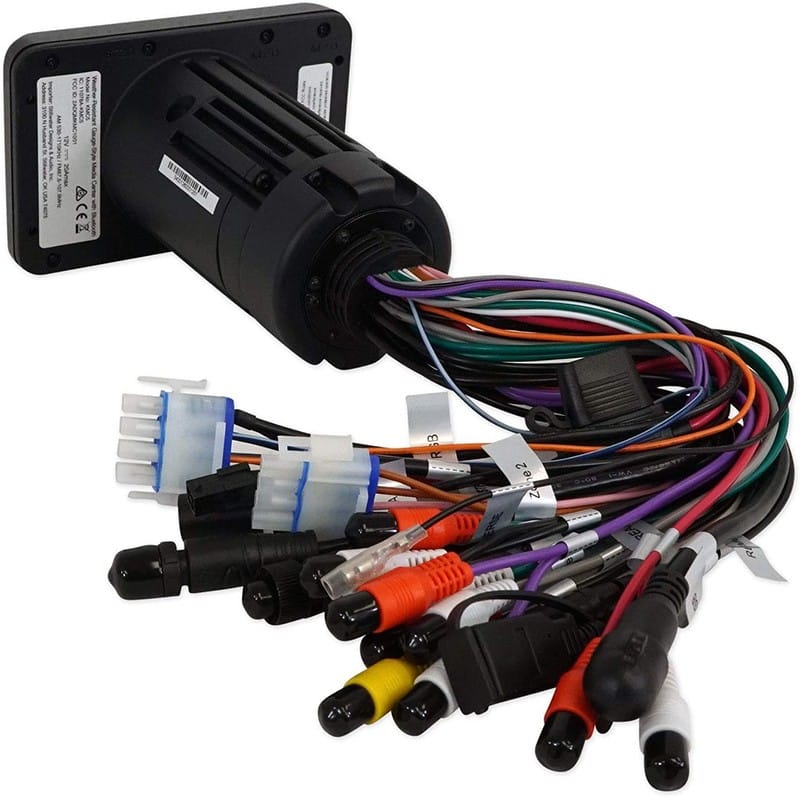
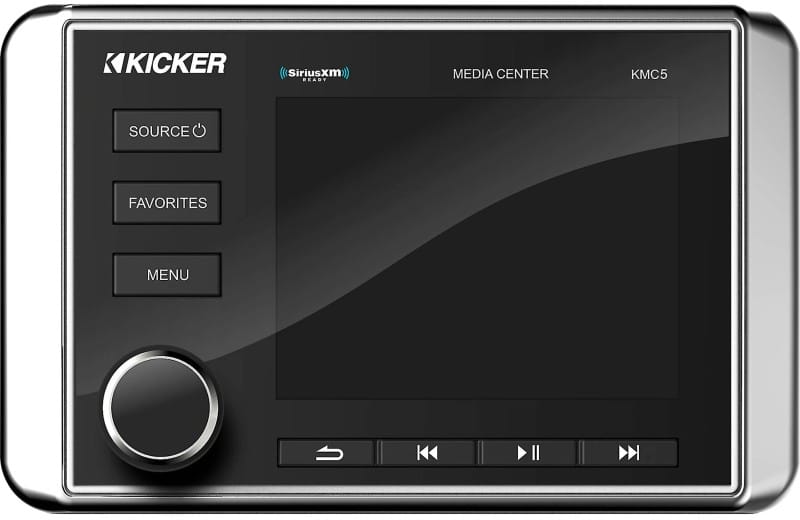
The KMC5 is a marine source unit with a face measuring 5.5 inches wide and 3.5 inches tall. The radio mounts through a three-inch hole, so it can replace a small round unit or a large gauge in an instrument cluster. If nothing else, drilling the mounting hole with a hole saw is much easier for your installer than cutting out a rectangle with an air saw. The radio needs about seven inches of clearance behind the mounting surface for the chassis and wire connections. The front panel is IP66 rated, so you don’t have to worry about rain or splashes causing issues. Of course, KICKER’s Real Marine rating means the radio is built with materials that won’t fade, chalk, crack, or corrode when exposed to the sun or saltwater.

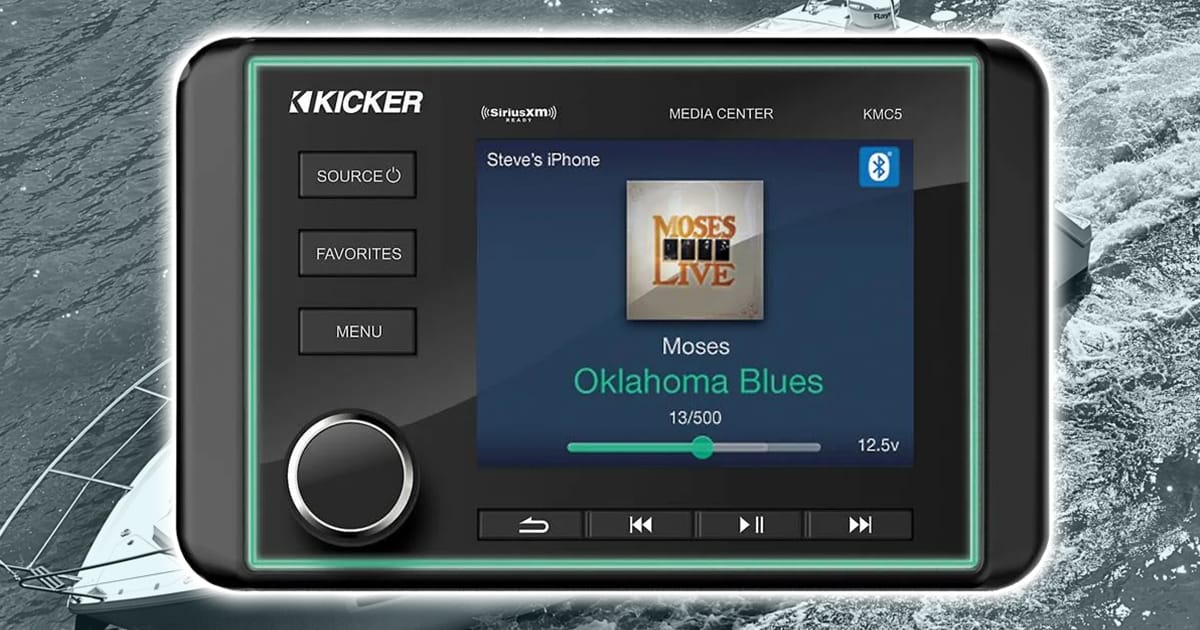
The radio features a sunlight-viewable 3.5-inch full-color LCD screen that provides a clear view of what’s playing from a USB thumb drive, SiriusXM satellite radio, or the built-in AM/FM tuner. USB support is compatible with FAT32-formatted thumb drives, and media formats include MP2, MP3, WMA, WAV16, FLAC, AAC, ALAC, and M4A. You can also stream music or a service like Pandora, iHeartRadio, Spotify, or Apple Music over the Bluetooth A2DP connection. The radio includes Bluetooth AVRCP so you can control your smartphone or media player from the source unit.

While we are on the topic of audio sources, it’s worth noting that the KMC5 includes a Weatherband tuner and an auxiliary input. You can use the input with something like a TV, DVD player or media player if you have a larger boat. Speaking of video, the KMC5 has a video input that can be used with an optional backup camera. There’s an external trigger included, so the rear camera can be activated with a switch at the helm. This would be a great option for backing a boat into a narrow slip at the marina.

If you’ve looked closely at the buttons on the face, then you might have seen the Favorite option. This is a quick-access button to whatever source, radio station or weather information channel you want.

KICKER KMC5
The front panel of the KMC5 radio features a 3.5-inch color display, making it easy to see what’s playing.

System Features and Specifications

Moving on from source options, we should discuss the outputs from the radio. The KMC5 includes six channels of amplification, each rated to deliver 25 watts into a 4-ohm load and 40 watts into a 2-ohm load. You’ll notice the power wire on the amp harness is larger than the typical 14- or 16-gauge conductor you’d find on a 22-watt x 4 radio. Your installer may need to run a dedicated 10-AWG cable for power and ground to the fuse panel at your point. Hey, if you want an amp, even one in a source unit, to produce power, you need to feed it power properly.

On the preamp side, the radio includes stereo front and rear outputs, a pair of subwoofer outputs and a 2-zone RCA output. The fifth and sixth speaker output connections are assigned to the second audio zone output. So, you could power speakers beside the TV, in the galley or a berth. If you are using the preamp outputs with a separate amplifier, the second audio zone might be ideal for a set of wakeboard tower speakers. This system design would give you separate control of the zone-2 volume. In fact, you can rename this separate zone to Tower, Transom, Cockpit, or Interior in the setup menu. You can also configure the Zone-2 volume to track the main volume or be adjustable on its own.

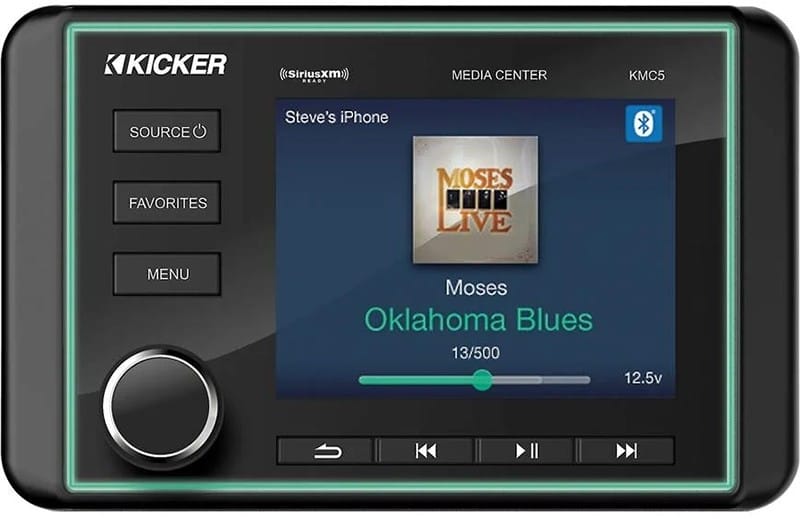
KICKER KMC5
The KICKER KMC5 features a dedicated second output zone that can function with the master volume control or on its own.

Audio Features

The KICKER KMC5 includes an adjustable high-pass crossover for the front and rear speaker and preamp outputs. The filter can be set to 50, 80, or 120 hertz to suit the size of the speakers in the system. The radio has two tone-control options. It has conventional bass, midrange and treble adjustability, or it can be switched to Custom EQ mode. The Custom EQ includes Rock, Pop, Jazz and custom options. In the custom menu, you can boost or cut audio at 50, 125, 250, 500, 1k, 3k, and 8k Hz center frequencies to fine-tune the system.

You can expand the KICKER KMC5 with the two-inch KRC12 remote or the KRC55 Digital remote. The KRC55 includes a color display that replicates what’s shown on the main radio screen.

KICKER KMC5
The KMC5 ships with black and chrome trim rings, so your installer can match the radio’s style to the rest of the helm.

Upgrade Your Boat with the KICKER KMC5 Today!

If you are in the market for a full-featured multimedia radio for your boat, or even a side-by-side or UTV, then drop by a local authorized KICKER retailer today and ask about the KMC5 radio. You can find a KICKER dealer near you by using the locator tool on their website.

Be sure to follow KICKER on Facebook, Instagram, and YouTube to learn more about their impressive car audio, marine, motorcycle, powersport and lifestyle product offerings.

This article is written and produced by the team at www.BestCarAudio.com. Reproduction or use of any kind is prohibited without the express written permission of 1sixty8 media.

Filed Under: ARTICLES, Marine Audio, Products, RESOURCE LIBRARY Tagged With: KICKER

The Basics of Digital Audio Compression

Digital Audio Compression

We recently talked about how the conversion from analog to digital works and explained some of the basic terminology associated with digital audio files. In this article, we are going to look at how different digital audio compression algorithms work to reduce file size so that files can be shared more easily.

The Basics of Digital Audio

Digital Audio CompressionAs we explained previously, sampling an analog audio waveform at CD-quality resolution requires 44,100 samples per second with a resolution of 16 bits for a pair of stereo channels. This results in a data stream that is 1,411 kilobits per second. For a one-minute long song, you’d need to store 84,672,000 bits of information. That’s about 50 megabytes for a five-minute song.

When we store audio in an uncompressed format, the information in the file doesn’t affect the size of the file. We could have a track containing a recording of a symphony orchestra, an audio test track or the last, last, last performance of the Rolling Stones. The size of the file will be the same if the track length is the same.

Lossless Audio Compression

Digital Audio CompressionReducing file size has always been a concern when it comes to transmitting a file. Back when we had dial-up internet service, it would take hours to download a whole song in an uncompressed format. Acoustic modems had an optimal transfer rate of about 300 bits per second. High-speed analog modems reached a peak of 48 kilobits per second using data compression algorithms. To transfer high-quality audio, it would take about 30 seconds for every second of music. See the problem?

One of the most popular and well-known file compression methods is to zip a file. Zipping a file analyzes the content of the file and replaces repeated strings of data with a shortcut to identical information. When you unzip the file, you get the original back without any modification.

In terms of audio compression formats, the most popular lossless formats are Free Lossless Audio Codec (FLAC), Apple Lossless Audio Codec (ALAC) and the Monkey’s Audio (APE) format in a distant third place.

In terms of compression, converting our 70.69 megabyte audio file to FLAC results in a file size of 37.5 megabytes. This is a reduction of about 50 percent with no loss of sound quality, accuracy or detail.

Lossy Audio Compression

Digital Audio CompressionWhether you are trying to shrink an audio file or a photograph, one of the easiest ways to reduce the file size is to throw away some of the detail in the original file. For audio files, this often means limiting high-frequency information and reducing the detail of or eliminating low-level signals.

If we convert our original audio file to a 320 kbps MP3 file, the file shrinks to an amazing 16.0 megabytes. We do so by throwing out audio information that is difficult to hear. For example, if there is a loud guitar riff in one channel, the compression algorithm can dramatically reduce the detail of the relatively low-level audio information in the other channel without much change in the perceived quality of the playback. This is called perceptual audio encoding because the algorithm specifically affects information that is more difficult to hear (or perceive).

At a compression rate of 320 kbps, most listeners can’t tell the difference between the original file and the compressed version. As the compression increases, the differences become much more apparent. We start to lose high-frequency information and detail.

Digital Audio CompressionIf we want to shrink the file further, we can convert it to a 128 kbps MP3 file. The benefit of extreme data compression is that our audio file now has a size of 6.59 megabytes. At this size, the song can be attached to an email without much concern for bandwidth or download time on a modern broadband internet connection.

The most popular lossy file compression formats are MP3 (formerly MPEG-1 Audio Layer III or MPEG-2 Audio Layer III), Adaptive Transform Acoustic Coding (ATRAC), Advanced Audio Coding (AAC) and Windows Media Audio (WMA).

Does File Size Matter?

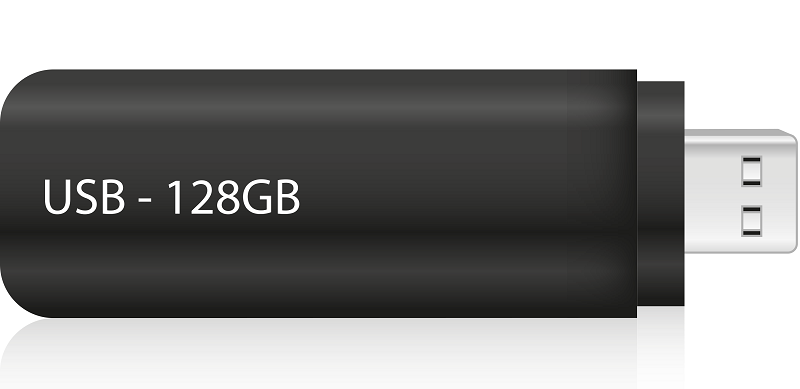
Digital Audio CompressionAs mentioned, audio compression algorithms were created to allow us to transmit audio over limited-bandwidth connections. Today, data storage is incredibly inexpensive. You can buy a 128 GB USB memory stick for less than $25. You can store about 400 hours of high-quality FLAC audio on a 128 GB memory stick. At the same time, internet bandwidth speed is at an all-time high. Most smartphones with LTE can download data at 150 mpbs. That’s faster than most people’s high-speed internet at home. Downloading a 37 megabyte file over a connection like that takes about five seconds.

Unless you are bandwidth-limited, you may as well download your music in at least CD-quality FLAC or an uncompressed WAV format. That way, you get the best sound quality possible from your audio system. If you have questions about how many tracks you can store on a memory stick or what digital media file formats are compatible with your car radio, visit your local mobile enhancement retailer. They should be able to answer any questions you may have.

This article is written and produced by the team at www.BestCarAudio.com. Reproduction or use of any kind is prohibited without the express written permission of 1sixty8 media.
Filed Under: ARTICLES, Car Audio, RESOURCE LIBRARY

  • 1
  • 2
  • 3
  • Next Page »

About TNT Audio

TNT Audio & Security has been a trusted name in mobile electronics and custom installation in Victoria, Texas since 1997. For nearly three decades, our team has helped drivers … [Read More...]

Recent Articles

The Audison APBX-10 AS2

Product Spotlight: Audison APBX 10 AS2

May 11, 2026 

One of the best upgrades you can make to your car audio system is to add a high-quality subwoofer. Whether you are working with a simple factory-installed radio and speaker system … [Read More...]

A USB hard drive laying on top of a pile of CDs

Understanding the Basics of Digital Audio Files

May 3, 2026 

If you are in your late 40s or older, then you likely grew up with a turntable or tape player in your home as a way of listening to store-bought music. Between 1982 and 1983, the … [Read More...]

A memphis audio subwoofer

Product Spotlight: Memphis Audio Power Reference Subwoofers

April 20, 2026 

There are hundreds of subwoofer options on the market. For a company to set itself apart from the competition is no easy feat. With that said, Memphis Audio has developed something … [Read More...]

KICKER KMC5

Product Spotlight: KICKER KMC5

April 6, 2026 

Going back a few decades, only a handful of car audio manufacturers offered marine-specific source unit options. These were often car radios with oversized front panels with … [Read More...]

A cellphone plugged into a vehicle with a charger

The Basics of Digital Audio Compression

April 5, 2026 

We recently talked about how the conversion from analog to digital works and explained some of the basic terminology associated with digital audio files. In this article, we are … [Read More...]

Subscribe!

Enter your email address to subscribe to our website and receive notifications of new posts by email.

Join 1 other subscriber

Testimonials

No Pressure

Reasonable prices and they listened to what I needed and did not try to sell me on products or services, no pressure. Larry is a very good salesperson!

Expert Knowledge

Hands down the best place to go to for audio and security. I've had 4 vehicles done here. Two 2010 Dodge 2500, an RV, and Scion TC. Larry always takes care of it. Quality work, outstanding service, expert knowledge.

These Guys are Great

They listened to my needs and went above and beyond to make it happen. These guys are great

Customers Leave Satisfied

Great selection and awesome customer service! 🙌🏽 Could not find these items ANYWHERE until I came to TNT Audio and Security. They are really informative to make sure you get what you want/need AND dedicated to ensure their customers leave satisfied.

Subscribe to Our Website

Enter your email address to subscribe to our website and receive notifications of new posts by email.

Location


Get Directions to 1sixty8 media

Services

  • Car Audio
  • Custom Installation
  • Marine Audio
  • Vehicle Security

Hours

Monday, Tuesday, Wednesday, Thursday, Friday9:00 am – 6:00 pm

Copyright © 2026 TNT Audio & Security · Privacy Policy · Website by 1sixty8 media · Log in

Loading Comments...