TNT Audio

Professional Mobile Electronics Since 1997

4803 N Navarro, Victoria, Texas 77904 361-576-6117
  • Home
  • Services
    • Car Audio
    • Custom Installation
    • Marine Audio
    • Vehicle Security
  • About Us
  • Location
  • Contact Us

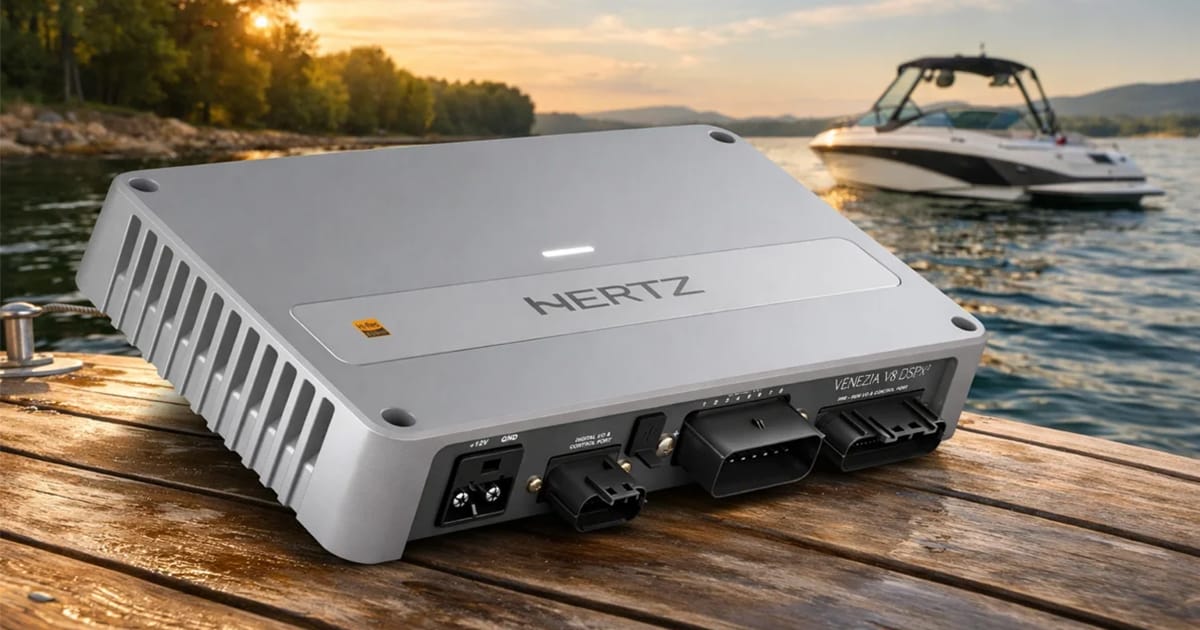
Hertz VENEZIA V8 DSPx² Explained: Marine-Grade DSP Amplifier for Tuned, Powerful Sound

Hertz VENEZIA V8 DSPx²

The Hertz VENEZIA V8 DSPx² is a marine-grade amplifier with a built-in digital signal processor (DSP) designed to power and tune an entire audio system from a single compact, marine-ready chassis. Combining eight channels of amplification with advanced signal processing, it allows a professionally designed system to deliver clean, controlled sound in boats and other harsh outdoor environments.

Modern marine audio systems face unique challenges. Wind noise, engine noise and open-air listening environments make it difficult to achieve balanced, detailed sound. A DSP amplifier like the VENEZIA V8 DSPx² allows a professional technician to precisely tune the system so music remains clear and dynamic even when conditions are less than ideal.

By combining amplification and signal processing in one product, the VENEZIA V8 DSPx² simplifies system design while providing the flexibility needed for high-performance marine audio systems.

The Technology Behind the Hertz VENEZIA V8 DSPx²
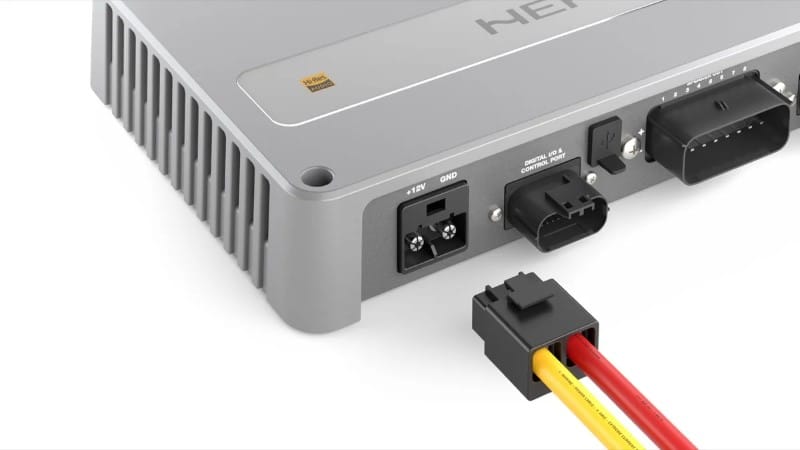
Close-up of the Hertz VENEZIA V8 DSPx² marine amplifier power and signal connections.
Close-up product details reinforce the amplifier’s purpose-built marine design and professional-grade system integration.

The defining technology in the Hertz VENEZIA V8 DSPx² is the integration of a high-performance multi-channel amplifier with advanced digital signal processing. This approach allows a professional retailer to power speakers and precisely control how audio signals behave throughout the entire system.

A digital signal processor (DSP) works by analyzing and modifying the audio signal before it reaches the speakers. In a vehicle or marine environment, speaker locations, reflective surfaces and background noise can dramatically affect how music sounds. The DSP allows technicians to correct these issues by adjusting crossover points, equalization, time alignment and output levels so the system performs as a cohesive whole.

In the VENEZIA V8 DSPx², the DSP and amplifier sections are engineered to work together from the start. This integration reduces the need for separate components and allows signal processing adjustments to directly influence amplifier output. The result is more precise control over the system’s tonal balance and dynamics, which is especially important in open-air listening environments where clarity and projection matter.

Another important advantage of this integrated design is system flexibility. An eight-channel amplifier provides multiple configuration options for powering speakers and subwoofers throughout a vessel. The DSP makes it possible to tailor each channel’s response to match the speaker type and its location within the boat, helping create a balanced listening experience across multiple seating areas.

Marine environments also place special demands on electronics. Moisture, vibration and temperature changes can affect performance and reliability. By combining signal processing and amplification within a single purpose-built marine amplifier, Hertz reduces system complexity while maintaining the durability needed for life on the water.

Key Features and Capabilities
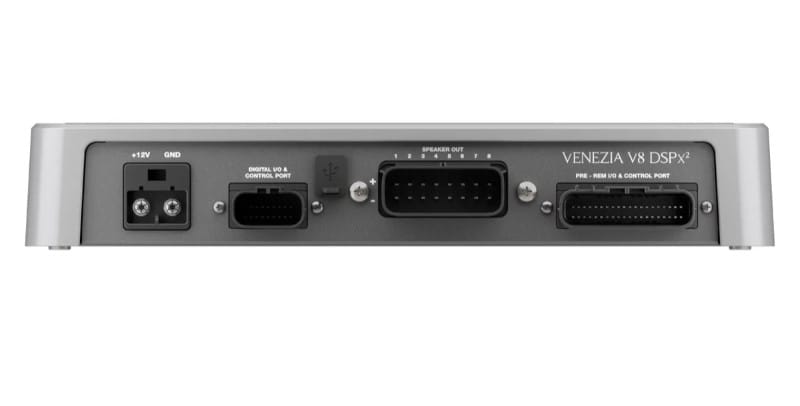
Connection panel on the Hertz VENEZIA V8 DSPx² marine DSP amplifier.
The rear panel highlights the amplifier’s integrated connectivity for multi-channel power and advanced system control.

The Hertz VENEZIA V8 DSPx² includes a range of technologies that support high-performance marine audio systems:

  • Eight Channels of Amplification: Provides the flexibility to power multiple speaker zones or combine channels for higher output when needed.
  • Integrated Digital Signal Processor (DSP): Allows professional system tuning including equalization, crossover configuration and time alignment for improved tonal balance.
  • Marine-Grade Construction: Designed to withstand moisture, salt exposure and vibration common in marine environments.
  • Compact System Architecture: Combining amplification and DSP processing reduces the number of components required in the system.
  • System Tuning Flexibility: Multiple output channels allow retailers to create tailored listening zones throughout the vessel.

Design And Construction
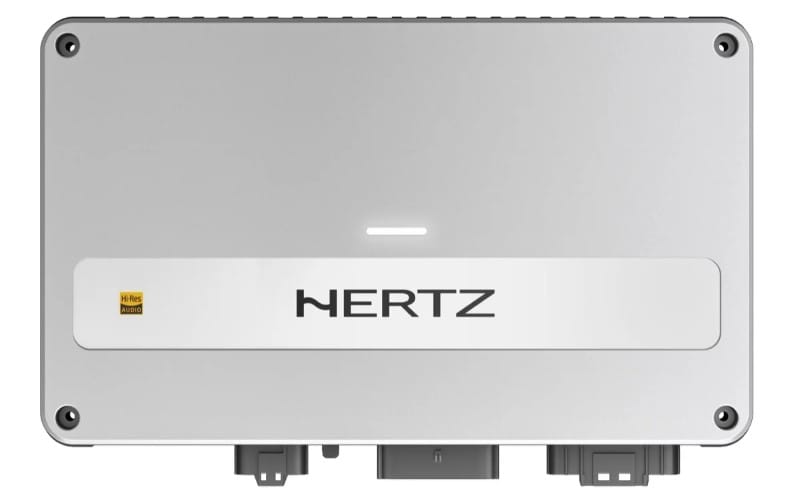
Top view of the Hertz VENEZIA V8 DSPx² marine DSP amplifier.
The low-profile chassis and clean industrial design reflect the amplifier’s premium marine-focused engineering.

The VENEZIA V8 DSPx² is engineered specifically for marine use, where durability is as important as performance. Marine electronics must withstand humidity, salt exposure and vibration without compromising reliability or sound quality.

Hertz designed the amplifier with protective materials and sealing strategies that help guard sensitive circuitry from environmental exposure. These measures help maintain consistent performance in challenging conditions often encountered on the water.

Thermal management is also critical in compact marine installations. Efficient amplifier design helps control heat buildup while maintaining stable output performance, even during extended listening sessions.

The result is a component built not only for sound quality but also for long-term reliability in marine environments.

Why This Product Matters for Vehicle Audio Upgrades

The Hertz VENEZIA V8 DSPx² matters because it allows a professionally designed audio system to deliver clear, balanced sound in environments where traditional systems struggle. By combining amplification and advanced signal processing, it gives system designers the tools needed to optimize every speaker in the system.

In open-air marine environments, music can easily become thin or uneven without proper tuning. A DSP amplifier allows professionals to shape the system’s response, so vocals, instruments and bass remain balanced across different seating areas.

For listeners, the result is a more immersive and enjoyable experience. Music sounds more natural, details become easier to hear and the system performs consistently even when background noise increases.

Upgrade Your Vehicle with Help from a Professional

Achieving the best performance from a DSP amplifier requires expert system design and precise tuning. A qualified specialty retailer has the tools and experience to integrate products like the Hertz VENEZIA V8 DSPx² into a system that delivers outstanding sound.

Visit the BestCarAudio.com Dealer Locator to find a trusted professional near you. A knowledgeable retailer can recommend the right equipment, design a system tailored to your vehicle and provide the expert calibration needed to bring your music to life.

This article is written and produced by the team at www.BestCarAudio.com. Reproduction or use of any kind is prohibited without the express written permission of 1sixty8 media.
Filed Under: Marine Audio, ARTICLES, Products, RESOURCE LIBRARY Tagged With: Hertz

Bang for Your Buck: Car Audio Subwoofer System Options

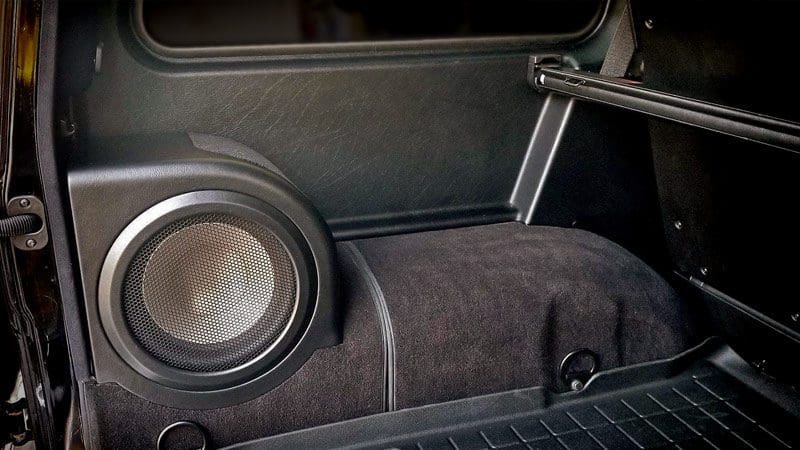
Car Audio SubwooferNo single upgrade to an audio system offers a larger improvement in sound quality than the addition of a car audio subwoofer. Adding a subwoofer not only improves the low-frequency performance of your sound system, it can also improve the clarity of the entire system and enhance the volume level capabilities of the smaller speakers in your car. In this issue of Bang for Your Buck, we are going to look at a few popular subwoofer upgrade options available for adding bass to your vehicle.
What is a Car Audio Subwoofer?

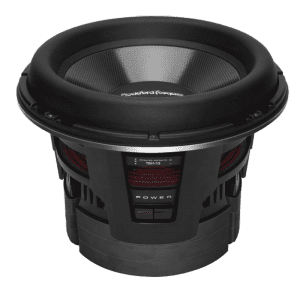
Car Audio SubwooferIn the simplest of terms, a subwoofer is a large speaker designed to play frequencies below 100 Hz at relatively high output levels. Subwoofers are most commonly available in 10- and 12-inch sizes, but 6.5-, 8-, 13.5- and 15-inch subs are also readily available.
To reproduce low-frequency information with authority, a speaker has to move a lot of air. In fact, for every octave lower a speaker is to play, it has to move four times as far to produce the same volume level. If your sub is moving 1 mm back and forth at 80 Hz, it has to move 4 mm at 40 Hz and an impressive 16 mm at 20 Hz. Most people find a pulsing bass line of 40–50 Hz to be fun. That said, feeling the rumble of deep bass like the introduction to “Boom Boom Pow” by the Black Eyed Peas or the pulse in Pink Floyd’s “Time” can cause goosebumps.

Subwoofer Power Handling

Most people associate subwoofers with their power-handling capabilities. While not a direct determining factor in the quality of a subwoofer, power handling is important in terms of choosing the right subwoofer for your sound system. If you want to listen to your sound system at high volume levels, you need powerful amplifiers and speakers that can handle that power while being able to move adequately to reproduce sound at high levels. It is no surprise that the output and power handling are directly related, since it takes amplifier power to make a speaker cone move.

Car Audio SubwooferPicking “enough” subwoofer depends on several factors. How loud is loud enough? How much space can you afford to give the subwoofer system? How powerful of an amplifier can your vehicle’s electrical system support? It can be difficult to choose the right sub based on these criteria, especially since different vehicles offer different amounts of cabin gain. Would a single 10-inch sub in a sealed enclosure in the back of a Honda Fit be a suitable solution in a Cadillac Escalade or short-cab Ford F-150?
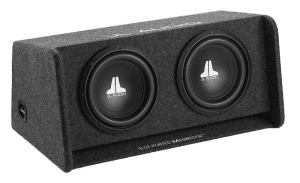
Custom-built Subwoofer Solutions

Your best choice to upgrade your vehicle with a subwoofer is to have your local mobile electronics specialist retailer design and construct a subwoofer system that is specific to your vehicle and your expectations. This process will start with your input in determining just how much bass you want. From there, your system designer can suggest a subwoofer or subwoofers that will meet your expectations.

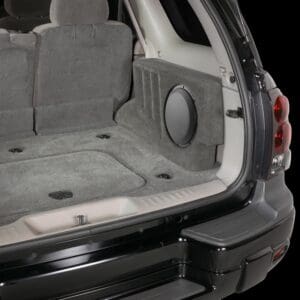
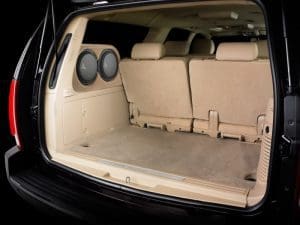
Car Audio SubwooferThe next step is to decide where to install the subs. The simplest of custom enclosures would be a rectangular wooden cabinet that sits in the trunk or cargo area of your vehicle. The dimensions of the enclosure can be optimized to make the most use of the available space. This optimization may include angling the back of the enclosure to follow the angle of the seats.

Depending on your goals and expectations, you may choose to have the enclosure finished in a material that matches the interior. For a more-customized look, you may want the enclosure wrapped in vinyl that is the same color and grain as the trim panels in your vehicle.

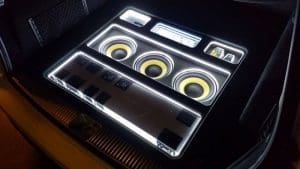
Car Audio SubwooferIf you want something truly unique, then ask about including LED lighting in the enclosure. You can choose to have a Lexan or Plexiglas window added and illuminate the interior of the enclosure or add acrylic plastic accent pieces that light up. Upgrades at this level are often combined with enclosures finished with multiple materials – different colors of vinyl can provide amazing cosmetics.
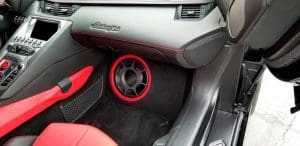
Advanced Subwoofer Enclosure Designs

Car Audio SubwooferThe next step, beyond a simple wooden enclosure, would be one that is shaped to fit the unique contours of your vehicle. Enclosures of this type are often built using a combination of wood and fiberglass or layers of wood that are stacked one on top of another to create complex contours. The most-common application like this is where a subwoofer is being fitted into the corner of a trunk or hatch area, but is also often placed under the trunk floor in a spare tire well. The passenger-side footwell of a two-seat vehicle is another popular location for this type of enclosure.

Due to the complexity of these enclosures, they will typically cost more. The trade-off is that they integrate better into your vehicle – providing you with the acoustic performance you want without taking up valuable cargo area.

Application-specific Subwoofer Systems

Car Audio SubwooferCompanies like JL Audio, MTX and Kicker offer subwoofer systems designed for specific models of vehicles. These enclosures are designed to offer impressive performance while minimizing how much space they use. Some companies construct these enclosures from fiberglass in large molds, while others use thick plastics. In most cases, while these enclosures are visible once installed, they are available in materials that match the color of the vehicle interior. An application-specific enclosure is a great way to add amazing bass to a vehicle quickly and efficiently.
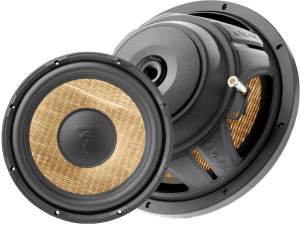
A subsection of these application-specific enclosures is truck boxes. No, not the thin, wedge-style enclosures that fit behind the seat, but complex enclosures that use the space under a rear bench seat in a pickup. Companies like Audio Enhancers, Bassworx and Atrend offer cost-effective solutions that will accept the subwoofer of your choice. In most of these applications, you need a shallow subwoofer because mounting depth is quite limited.

Shallow Subwoofers

Car Audio SubwooferYou’ll note that we haven’t discussed the specific features of subwoofers that differentiate one from another. This omission is quite deliberate because we will dedicate an entire article to that topic. In the meantime, it is worth discussing the difference between a conventional subwoofer and a shallow-mount design.


Shallow subwoofers were originally designed for use behind the seat of a pickup truck. Shallow cones, baskets and motor structures provide mounting depths of around 3 to 3.5 inches. Historically, the tradeoff for this reduced mounting depth has been a dramatic decrease in cone excursion capability. Over the past few years, companies like JL Audio, Illusion Audio, Kicker, Focal, Rockford Fosgate, ARC Audio and Audiomobile have worked hard to maximize the performance of their shallow-mount subwoofers to the point that they offer similar, if not better, performance than some conventional designs.

Audition a Subwoofer System Today!

We will leave you with this as the starting point for choosing a subwoofer solution for your vehicle. In the next article, we’ll explain the performance benefits and drawbacks of different subwoofer enclosure designs, then wrap up our buyer’s guide series with an explanation of advanced subwoofer design features that offer audible improvements in performance. Until then, visit your local specialist mobile enhancement retailer and audition one of their demo vehicles that has a subwoofer. We are sure you’ll be impressed and want one for your car or truck.
Car Audio SubwooferNo single upgrade to an audio system offers a larger improvement in sound quality than the addition of a car audio subwoofer. Adding a subwoofer not only improves the low-frequency performance of your sound system, it can also improve the clarity of the entire system and enhance the volume level capabilities of the smaller speakers in your car. In this issue of Bang for Your Buck, we are going to look at a few popular subwoofer upgrade options available for adding bass to your vehicle.

What is a Car Audio Subwoofer?

Car Audio SubwooferIn the simplest of terms, a subwoofer is a large speaker designed to play frequencies below 100 Hz at relatively high output levels. Subwoofers are most commonly available in 10- and 12-inch sizes, but 6.5-, 8-, 13.5- and 15-inch subs are also readily available.

To reproduce low-frequency information with authority, a speaker has to move a lot of air. In fact, for every octave lower a speaker is to play, it has to move four times as far to produce the same volume level. If your sub is moving 1 mm back and forth at 80 Hz, it has to move 4 mm at 40 Hz and an impressive 16 mm at 20 Hz. Most people find a pulsing bass line of 40–50 Hz to be fun. That said, feeling the rumble of deep bass like the introduction to “Boom Boom Pow” by the Black Eyed Peas or the pulse in Pink Floyd’s “Time” can cause goosebumps.

Subwoofer Power Handling

Most people associate subwoofers with their power-handling capabilities. While not a direct determining factor in the quality of a subwoofer, power handling is important in terms of choosing the right subwoofer for your sound system. If you want to listen to your sound system at high volume levels, you need powerful amplifiers and speakers that can handle that power while being able to move adequately to reproduce sound at high levels. It is no surprise that the output and power handling are directly related, since it takes amplifier power to make a speaker cone move.

Car Audio SubwooferPicking “enough” subwoofer depends on several factors. How loud is loud enough? How much space can you afford to give the subwoofer system? How powerful of an amplifier can your vehicle’s electrical system support? It can be difficult to choose the right sub based on these criteria, especially since different vehicles offer different amounts of cabin gain. Would a single 10-inch sub in a sealed enclosure in the back of a Honda Fit be a suitable solution in a Cadillac Escalade or short-cab Ford F-150?

Custom-built Subwoofer Solutions

Your best choice to upgrade your vehicle with a subwoofer is to have your local mobile electronics specialist retailer design and construct a subwoofer system that is specific to your vehicle and your expectations. This process will start with your input in determining just how much bass you want. From there, your system designer can suggest a subwoofer or subwoofers that will meet your expectations.

Car Audio SubwooferThe next step is to decide where to install the subs. The simplest of custom enclosures would be a rectangular wooden cabinet that sits in the trunk or cargo area of your vehicle. The dimensions of the enclosure can be optimized to make the most use of the available space. This optimization may include angling the back of the enclosure to follow the angle of the seats.

Depending on your goals and expectations, you may choose to have the enclosure finished in a material that matches the interior. For a more-customized look, you may want the enclosure wrapped in vinyl that is the same color and grain as the trim panels in your vehicle.

Car Audio SubwooferIf you want something truly unique, then ask about including LED lighting in the enclosure. You can choose to have a Lexan or Plexiglas window added and illuminate the interior of the enclosure or add acrylic plastic accent pieces that light up. Upgrades at this level are often combined with enclosures finished with multiple materials – different colors of vinyl can provide amazing cosmetics.

Advanced Subwoofer Enclosure Designs

Car Audio SubwooferThe next step, beyond a simple wooden enclosure, would be one that is shaped to fit the unique contours of your vehicle. Enclosures of this type are often built using a combination of wood and fiberglass or layers of wood that are stacked one on top of another to create complex contours. The most-common application like this is where a subwoofer is being fitted into the corner of a trunk or hatch area, but is also often placed under the trunk floor in a spare tire well. The passenger-side footwell of a two-seat vehicle is another popular location for this type of enclosure.

Due to the complexity of these enclosures, they will typically cost more. The trade-off is that they integrate better into your vehicle – providing you with the acoustic performance you want without taking up valuable cargo area.

Application-specific Subwoofer Systems

Car Audio SubwooferCompanies like JL Audio, MTX and Kicker offer subwoofer systems designed for specific models of vehicles. These enclosures are designed to offer impressive performance while minimizing how much space they use. Some companies construct these enclosures from fiberglass in large molds, while others use thick plastics. In most cases, while these enclosures are visible once installed, they are available in materials that match the color of the vehicle interior. An application-specific enclosure is a great way to add amazing bass to a vehicle quickly and efficiently.

A subsection of these application-specific enclosures is truck boxes. No, not the thin, wedge-style enclosures that fit behind the seat, but complex enclosures that use the space under a rear bench seat in a pickup. Companies like Audio Enhancers, Bassworx and Atrend offer cost-effective solutions that will accept the subwoofer of your choice. In most of these applications, you need a shallow subwoofer because mounting depth is quite limited.

Shallow Subwoofers

Car Audio SubwooferYou’ll note that we haven’t discussed the specific features of subwoofers that differentiate one from another. This omission is quite deliberate because we will dedicate an entire article to that topic. In the meantime, it is worth discussing the difference between a conventional subwoofer and a shallow-mount design.

Shallow subwoofers were originally designed for use behind the seat of a pickup truck. Shallow cones, baskets and motor structures provide mounting depths of around 3 to 3.5 inches. Historically, the tradeoff for this reduced mounting depth has been a dramatic decrease in cone excursion capability. Over the past few years, companies like JL Audio, Illusion Audio, Kicker, Focal, Rockford Fosgate, ARC Audio and Audiomobile have worked hard to maximize the performance of their shallow-mount subwoofers to the point that they offer similar, if not better, performance than some conventional designs.

Audition a Subwoofer System Today!

We will leave you with this as the starting point for choosing a subwoofer solution for your vehicle. In the next article, we’ll explain the performance benefits and drawbacks of different subwoofer enclosure designs, then wrap up our buyer’s guide series with an explanation of advanced subwoofer design features that offer audible improvements in performance. Until then, visit your local specialist mobile enhancement retailer and audition one of their demo vehicles that has a subwoofer. We are sure you’ll be impressed and want one for your car or truck.

This article is written and produced by the team at www.BestCarAudio.com. Reproduction or use of any kind is prohibited without the express written permission of 1sixty8 media.

Filed Under: ARTICLES, Car Audio, RESOURCE LIBRARY

The Importance Of Professional Mobile Electronics Installation

Installation
Photo courtesy of Prestige Car Audio And Marine

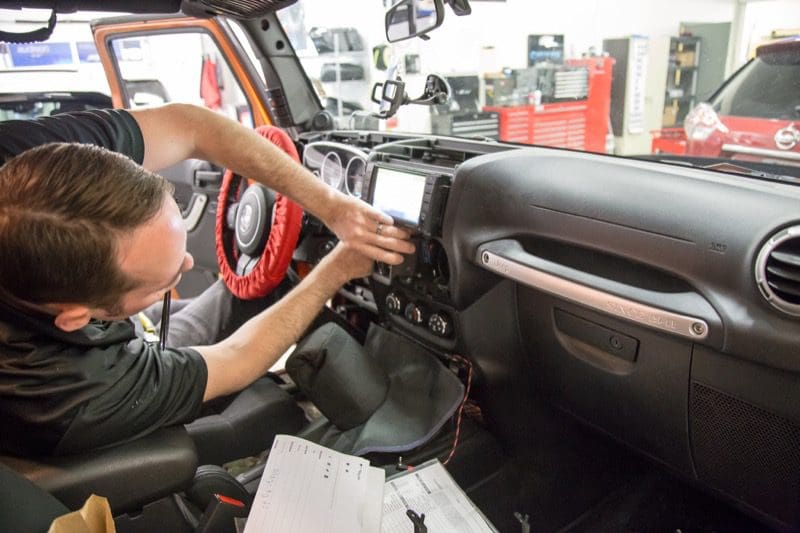
Several aspects of the automotive industry have always been embraced by hobbyists and do-it-yourself enthusiasts. Being able to say that you created something with your own bare hands would make anyone feel proud. In the mobile electronics industry, carmakers have been rapidly advancing the technology used in new cars. From computer data networks and advanced vehicle construction materials to elaborate factory audio system tuning, all of these technologies present unique challenges that many people simply aren’t aware of. Failure to compensate for these can wreak havoc with your vehicle’s electrical system, damage the products you are installing or simply result in poor performance from your audio equipment.

Let’s look closely at why it’s best to put the reliability of your vehicle, and the performance of your audio equipment, in the hands of a a shop offering professional installation.

Computers

Installation

Automobile manufacturers are always striving to make their vehicles as fuel-efficient as possible while offering the latest technologies and features. One way they save weight is by putting different devices and computers on a computer data network. Rather than running a myriad of control wires from component to component, they run power and ground, and a pair of data wires. Everything from door locks and trunk release modules to ABS brake and traction control systems can talk to each other on the data network.

Where these networks pose a challenge is when you want to add or remove something from the vehicle. Say you have a vehicle that has a secondary radio display in the dash, but you want to upgrade your audio system. The display may get very upset when you take the radio away. Likewise, you typically can’t add new devices to the data network to add new features.

Your car audio specialist retailers have the experience to work with these data networks. They know what interfaces are available for options like a remote starter or backup camera integration, and they have the manufacturer support to program and install them without causing Check Engine or MIL lights.

Reliability

When working on a vehicle, there are many different ways to run wires and make electrical connections. Automotive mechanics know that it’s hard to beat the knowledge and experience that a veteran car audio installer possesses when it comes to working on vehicle electrical systems. They make dozens, if not hundreds, of electrical connections each and every day.

InstallationThe connections are electrically sound, offering little to no resistance to current flow. Equally, the connections are mechanically sound, ensuring that they will be at least as reliable as the factory connections, if not much better.

Finally, many shops use materials like split loom, nylon sleeves or cloth tape to protect wires as they run through the vehicle. These protective coverings also make the wiring look as if it came from the factory.

Product Warranty

Many mobile electronics manufacturers offer extensions on their product warranties when the products are sold and installed by an authorized dealer. Authorized retailers have been trained on the features of the products they sell. In the case of high-end brands, this training often extends to techniques and methodologies that make the products sound better in your vehicle, and subsequently last longer. The proper installation and configuration of mobile electronic components is the key to their performance and reliability.

Audio Integration

Installation

Factory audio systems are becoming more and more complicated. They still don’t rival what is available from the aftermarket, but they have improved. One big step automakers have made in the performance of their audio systems is in their tuning. More and more factory source units and amplifiers include advanced equalization and time correction to maximize the performance of the audio system. When it comes time to upgrade these systems, installers have the techniques and equipment required to test the signals going to the speakers to determine if signal correction is required. If you omit signal correction when installing a new speaker, the tuning that made a cheap factory speaker sound mediocre will work against you, and make a great speaker sound only so-so. Factory audio system signal measurement and correction is now a way of life for a car audio installer.

Modern Vehicle Chassis Design

Did you know that automakers are now using aluminum panels in the construction of their vehicles? In the ongoing battle to reduce weight, the use of aluminum will continue to increase year after year. The downside for the mobile electronics enthusiast is that aluminum is not as good a conductor of electrical current as steel is. In fact, pound for pound, it offers 30% more resistance to the flow of electrical current. This dramatically affects the amount of current we can deliver to high-power audio amplifiers.

Worse than the fact that they are using aluminum is that they have also started using structural adhesives to bond panels together. Spot welds are quick, but they only connect a small area. A good bead of 3M, Loctite or Proform structural adhesive between two aluminum panels connects the entire overlapping surface of the panel together. There is less chance of movement and less chance of corrosion. There’s a downside to this as well: These structural adhesives do not conduct electricity.

If you work with experienced installers, they know how to deal with vehicles that have aluminum chassis and/or adhesive construction. Failure to compensate for these modern construction methods could result in damaged equipment and poor performance.

Choose Professional Installation

For most people, their vehicle is their second-most expensive purchase after their homes. When it comes time to have work done, the knowledge and experience of a trained professional can help ensure that you get all the performance you want from your purchase without any of the headaches of nonprofessional installation. Contact your local car audio specialist retailer today.

This article is written and produced by the team at www.BestCarAudio.com. Reproduction or use of any kind is prohibited without the express written permission of 1sixty8 media.

Filed Under: Car Audio, ARTICLES, RESOURCE LIBRARY

Subwoofer Enclosures, More Than Just a Box

Subwoofer EnclosuresFor decades, there has been discussion after discussion about which of the different subwoofer enclosures are “the best” and why. Let’s take a look at why we need a subwoofer enclosure at all, and how the three popular styles – sealed, vented and bandpass – differ in their design and performance.

Back-Wave Management

If you were to hook any speaker up to an amplifier, hold it in your hand and play music into it, you would find that you don’t hear any bass. That is because the sound coming from the front of the speaker cancels out the sound coming from the back. We need a way to keep the sound coming from the back of the speaker cone from interfering with the sound coming from the front. If you were to cut a hole in the middle of a large, flat piece of wood and mount the speaker in it, you would hear a lot more bass. In fact, until the half-wavelength of the bass frequencies becomes longer than the dimensions of the piece of wood, you will get really good, solid bass. If we put a speaker in an airtight enclosure, none of the sound coming from the back interferes with the sound coming from the front.

Power Handling

Subwoofer Enclosures
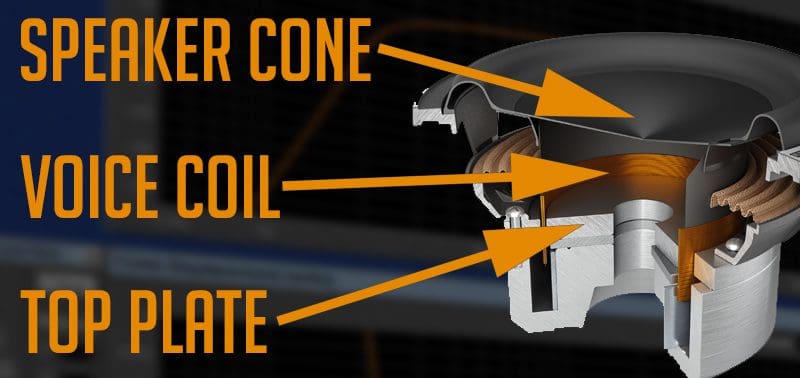
Different parts of the subwoofer determine its excursion and power handling.

The ability of a speaker to use the power produced by an amplifier is limited by two criteria – how far the speaker cone can move and how much heat the voice coil of the speaker can handle. Thermal power-handling limitations are based primarily on the design of a speaker – the size of the voice coil, how airflow is managed around the voice coil and the proximity of the stationary components of the motor assembly to the voice coil are the key contributing factors. The excursion-limited constraints are also part of the speaker’s design – how long the voice coil winding is, how tall the top plate is and how much suspension travel is available are the key factors.

Excursion

When it comes to reproducing bass, a speaker has to move four times as far each time the input frequency is halved. For example, a speaker moving 0.125 inches at 100 Hz has to move 0.5 inches to reproduce the same output level at 50 Hz and 2 inches at 20 Hz. You can see that, for the lowest of frequencies, cone excursion limitations are significant – very few speakers can move 2 inches without significant distortion.

When we put a speaker in an enclosure, the combination of the enclosure and the speaker create a high-pass filter. We are effectively decreasing the low-frequency output of the speaker. Why would we want to do this? The benefit of an enclosure is that we can control the motion of the speaker cone. Looking at a simple acoustic suspension (also known as a sealed) enclosure will be the simplest illustration of this explanation.

Compliance

Each and every speaker – from the biggest of subwoofers to the smallest of tweeters – has a springiness to the cone. We call this the compliance. We measure compliance by comparing it to a volume of air with the equivalent springiness. We call this characteristic of the speaker Vas. In general terms, a speaker with a very small Vas specification has a tight suspension, and a speaker with a large Vas has a softer suspension. There is a lot more to it than that, but for the discussion of enclosure features and benefits, that’s all we need to get into for now.

Subwoofer EnclosuresWhen we put a speaker in an enclosure, we stiffen the suspension. When you push in on the speaker cone, you are pushing against the speaker’s suspension (which wants to center the cone) and you are trying to pressurize the air in the enclosure. When the cone tries to move outward from rest, you are putting the air in the into a vacuum state – it wants to pull the cone back to its resting position. We do sacrifice low-frequency output, but we gain significant power handling and control over the motion of the speaker cone. For the latter, the combination of the air in the enclosure and the speaker suspension helps to stop the speaker cone from moving once an electrical signal starts it in motion.

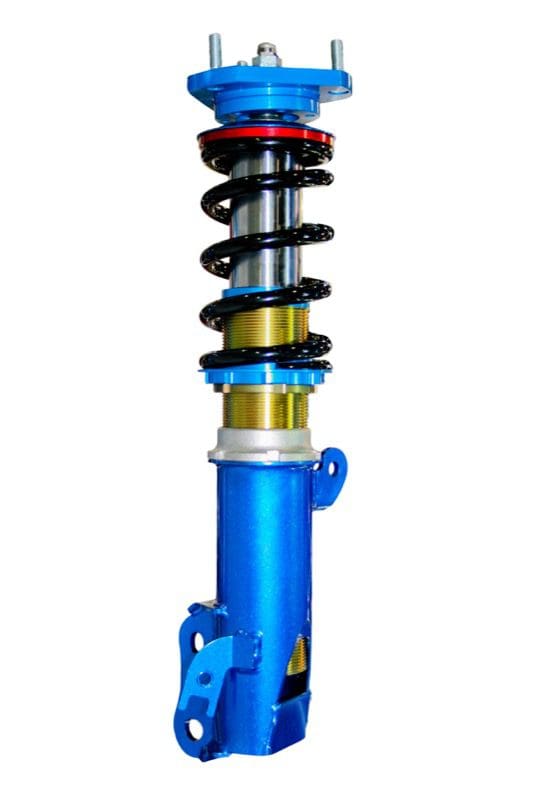
Think of it like a shock absorber on a vehicle. You can see that having an enclosure is critical.

Acoustic Suspension Subwoofer Enclosures

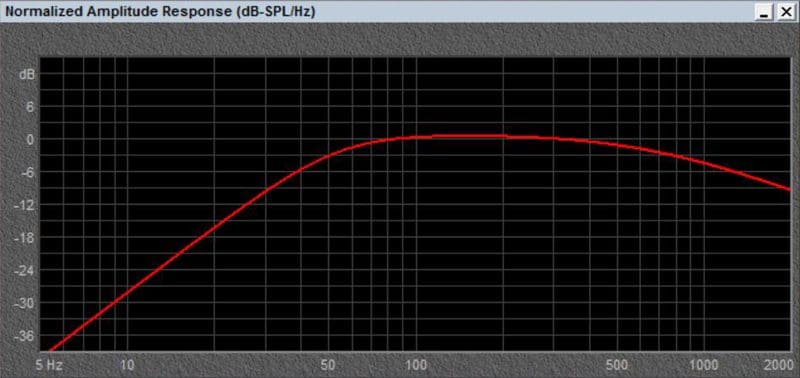
The simplest of enclosures is called an acoustic suspension or sealed enclosure. In these enclosures, we are putting the speaker into an airtight box. When we put a speaker in an enclosure, the system resonates at a specific frequency that – we call this Fc. Below that frequency, the output is reduced at a rate of -12 dB per octave. If the system has a resonant frequency of 50 Hz, the output will be 12 dB quieter at 25 Hz.

Subwoofer Enclosures
Here we see the smooth response of the sealed enclosure.

Acoustic suspension enclosures are amongst the smallest of the different enclosures we will discuss. They are also the easiest to construct, and most forgiving regarding calculation error. If you combine the roll-off of the enclosure and speaker system with the increase in efficiency you get from the relatively small air volume of the vehicle interior (often called transfer function or cabin gain), you can get a very flat in-car response with good infrasonic output. Bass from an acoustic suspension enclosure is very tight and controlled, thanks to excellent transient response.

There is a down side. If you are looking for loud bass, then you need a driver that has a lot of excursion capability, and you need a reasonable amount of power to move the speaker cone back and forth to get the level of output you want. There is another drawback that isn’t talked about as much, and that is distortion. As a speaker increases in excursion, the amount of distortion it creates increases. Likewise, distortion increases near the resonant frequency of the speaker. So, what can you do?

Bass Reflex Subwoofer Enclosures

A bass reflex (also known as ported or vented) enclosure uses a vent to increase low-frequency output by making use of the speakers back-wave energy. The vent, often a round tube or sometimes a rectangular slot, has an area and a length. The specific area and length of the vent and their relationship to the total volume of the enclosure cause the column of air in the vent to resonate at a specific frequency when excited by the speaker. We typically tune bass reflex enclosures quite low to emphasize the bottom octave or so of the audible frequency range. They can be tuned higher to increase efficiency for high-SPL applications. There is always a sacrifice, though – when we tune the enclosure higher, we sacrifice low-frequency performance.

Bass reflex enclosures are typically larger than sealed enclosures. There is no hard-and-fast rule to associate with the size relationship, but 25–50% large is common. The trade-off for that extra volume is two-fold – more efficiency in the tuning frequency and more power handling, at some frequencies.

When the subwoofer used in a bass-reflex subwoofer enclosure produces frequencies around the resonant frequency of the vent/enclosure combination, the driver excursion is reduced to almost nothing and all the “work” is done by the vent. Put more succinctly, around the tuning frequency, most of the music is being produced by the vent. The benefit to this is that power-handling problems caused by cone excursion limitations are dramatically increased. Since the cone is barely moving, very high sound pressure levels can be achieved. Around the tuning frequency, power handling is limited by the thermal capabilities of the subwoofer.

As we mentioned earlier, one factor that contributes to loudspeaker distortion is cone excursion. With a bass reflex enclosure, the driver moves significantly less than with an acoustic suspension enclosure design. As long as the vent itself has enough area and a smooth transition at both openings, the distortion produced by a properly designed bass reflex enclosure can be impressively small.

Subwoofer Enclosures
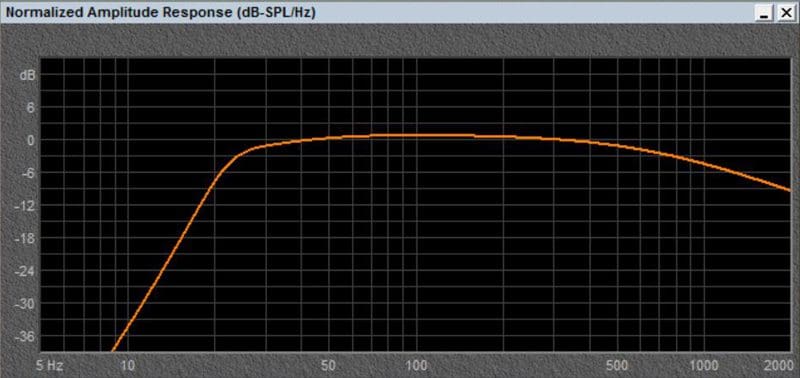
Notice the rapid dropoff of the low end response (on the left) of this vented enclosure graph.

Nothing is free, is it? A factor in deciding to use a bass reflex design is how fast the output decreases below the tuning frequency. Where an acoustic suspension enclosure rolls off at -12 dB per octave, a bass reflex enclosure rolls off at 24 dB per octave. Below the tuning frequency, the vent acts more and more like a hole in the enclosure, offering increasingly less back pressure as frequency decreases. Designing for, and managing, driver excursion is a fundamental part of bass reflex enclosure design.

Bandpass Subwoofer Enclosures

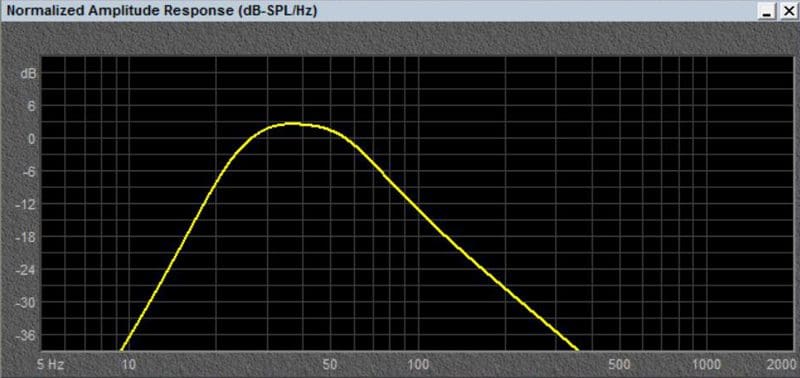
We will quickly touch on bandpass enclosures to wrap up this article. There are several different designs for bandpass enclosures. Some use a sealed enclosure, and some a vented one. Independent of whether the rear chamber is sealed or vented, the output of the subwoofer plays into a vented enclosure. This enclosure acts as a low-pass filter. Why would we want to design a bandpass enclosure?

Subwoofer Enclosures
The reason for the name “bandpass” is easy to see when one looks at the response curve of the bandpass enclosure.

First and foremost, all of the output of the enclosure is produced by the vent or vents. This allows a creative designer to build an enclosure in the trunk of a vehicle and have the vent opening play through the rear parcel shelf. There have been some amazing bandpass enclosures build in the front storage area of mid- or rear-engine vehicles. The vent allows the bass to enter the interior of the vehicle. Bandpass enclosures can also offer impressive gains in efficiency over acoustic suspension and bass reflex enclosures, but they do so at the sacrifice of bandwidth and enclosure volume.

A bandpass enclosure has two resonant frequencies – one for each of the enclosures. The resultant management of cone excursion can allow a great deal of bass to be produced from limited excursion drivers. While the speaker cone itself does not move a great deal, the amount of work done by the motor assembly is still significant. You are still putting power into the speaker, and work is being done. Because the front chamber of the enclosure acts as a filter, it can also be very difficult to hear when the speaker is distorting.

Regarding the complexity of design, and forgiveness of construction error, bandpass enclosures are the most complicated to execute perfectly. Unlike an acoustic suspension or bass-reflex design, bandpass enclosure designs must be tailored exactly to the speaker they are being used with. Never trust the concept of a “generic” bandpass enclosure.

Lastly, because a bandpass enclosure includes an acoustic low-pass filter, it has to be used with good-quality, appropriately sized midbass drivers. If not, the bass can sound lost or disconnected relative to the rest of the music.

For More Details On Subwoofer Enclosures, Visit Your Local Specialist

As you can see, there are many ways to install a subwoofer – or any speaker, for that matter. Navigating the available space in the vehicle, as well as different speaker sizes and designs, can be tricky. The design and construction of an enclosure can be complex, especially when complex shapes are involved. Visit your local car audio specialist retailer to explore different enclosure options for your vehicle.

This article is written and produced by the team at www.BestCarAudio.com. Reproduction or use of any kind is prohibited without the express written permission of 1sixty8 media.

Filed Under: Car Audio, ARTICLES, RESOURCE LIBRARY

Power Wire: OFC versus CCA

Power WireWhen it comes to high-current wiring in a vehicle, there are two types of stranded power wire available: solid copper and copper-clad aluminum. This article looks at the differences between each kind of wire, and explain the challenges of ensuring your high-current device gets the power it needs to do the job you want done.

Car Audio Power Wire: Background

Power WireIn mobile applications, or anywhere that a conductor may be exposed to movement or vibration, it is recommended to use only stranded conductors. Solid conductors (like single-strand house wiring) may offer slightly more conductor area for a given wire diameter, but over time, the solid wire can work-harden, become brittle and eventually break from repeated back-and-forth motion. Imagine using large-gauge solid copper wires in the wire boot in a door jamb or to your trunk or hatch lid. That is a recipe for disaster.

The term OFC (oxygen-free copper) has become abused and is used synonymously with solid or all-copper conductors. In actuality, OFC is a type of solid copper. When molten copper is cast and drawn into a conductor, the process to make an OFC conductor reduces the oxygen content of the wire. If all is done perfectly, the copper-oxygen content is around 42 parts per million (PPM) vs. a conventional copper with content that is roughly six times that amount.

In the mobile electronics industry, there is no way to know if the solid copper conductor you are purchasing is oxygen-free or not unless you can witness the casting process in person. Everyone in the industry uses “OFC” for a piece of wire that is not copper-clad aluminum (CCA).

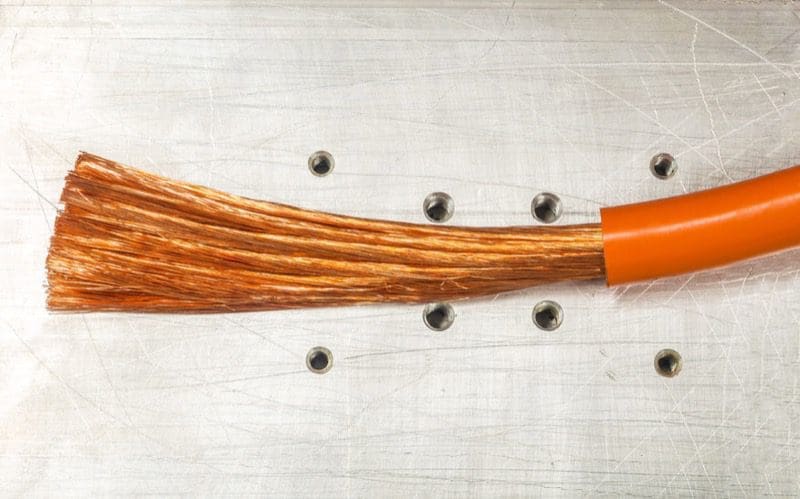
Looking at the alternative, we have CCA conductors. In these conductors, the core of the wire is a cylinder of aluminum and around it is a layer of copper. From the side, it looks like copper, but if you cut off a piece and look at the end, you can see the gray aluminum content.

There are further variations. Some companies manufacture all-copper strand wire but coat the outside of each strand with a thin layer of tin to help prevent corrosion.

Car Audio Power Wire: Size

When it comes to flowing electricity, or, more specifically, flowing electrons, the most important thing to consider is wire size. In the mobile electronics industry, we use the American Wire Gauge (AWG) standard. This sets a specific diameter for a conductor. It’s not a debatable number – the conductor either meets the standard or it doesn’t.

Here is where the games begin. There is a second term used in our industry: gauge. In the steel sheet industry, gauge is an important tool for specifying material thickness. In car audio, it means nothing. If you have been around the industry for any amount of time, you will have seen wires that claim to be 0 gauge but have a conductor area equivalent to a 6 AWG. If a wire is labeled as 4 gauge, then sadly, you have no way of knowing how big it is, other than attempting to measure it.

Cutting a wire and looking at the area also doesn’t always tell the story. Some wires are wound quite loosely. This makes the wire very flexible, but does so because there is space around the strands. You sacrifice effective cross-sectional conductor area for flexibility.

Car Audio Power Wire: Materials

Power WireIn solid copper stranded wire, we ideally want everything to be pure copper. That said, pure copper is quite expensive, even though the cost of pure copper has come down over the past few years; it currently sits at around $2.00–$2.25 a pound on the commodities market. When a manufacturer wants to purchase wire, there are many options: strand count, how the strands and bundles are woven, how tightly they are woven, and so on. Manufacturers also have a choice in the “kind” of copper they make the conductors with. It could be pure copper, recycled copper or a copper alloy. Again, you have no way of knowing unless you are witness to the process.

Don’t let the variations in copper scare you. A solid copper conductor always outperforms a CCA conductor. The biggest challenge with car audio CCA wiring is that it does not, and will not, specify the ratio of copper to aluminum. There are publically displayed measurements of different CCA wire samples where a smaller-diameter wire outperforms a slightly larger wire because it has less aluminum and more copper. Unless you measure it yourself, you just don’t know.

On its own, pound for pound, aluminum has about 60% more resistance to the flow of electricity. When we talk about CCA wire, there is some copper in there; in most cases, the difference diminishes to 30 to 40%.

Car Audio Power Wire: The Challenge

Power Wire
This Audison Connection Power Kit Features OFC Copper wire.

When you look at car audio wiring, there is no way to know what you are getting with a CCA amp kit or roll of wire. Some manufacturers make CCA wire that functions nearly as well as solid copper. In fact, one company makes an oversized CCA that has less resistance per foot than solid copper. The downside is that the wire doesn’t fit into a lot of connectors or terminal blocks. Overall, unless you want to take the time to measure the properties of the kit you are buying, it is better to stick to solid copper.

From the standpoint of long-term benefits, solid copper wire resists corrosion much better than CCA wiring. In climates where road salt or brine is used in the winter to keep surfaces clear of ice, we have seen instances where unprotected CCA power wires have failed completely in less than two years. Why risk the performance of your audio system, when you can simply choose the solid copper wire?

How do you know if you are getting something good? The Consumer Technology Association (formerly the Consumer Electronics Association) has developed a standard for wiring. It is called CTA-2015 (formerly CEA-2015) specification. It describes the minimum standards for wiring for use in mobile electronics applications. The standards include that the wire must be stranded solid copper, the minimum number of strands for a given AWG wire size, and the area of the wire and its maximum resistance. If you stick to the brands that support the CTA-2015 standard, you should never have any problems.

This article is written and produced by the team at www.BestCarAudio.com. Reproduction or use of any kind is prohibited without the express written permission of 1sixty8 media.

Filed Under: ARTICLES, Car Audio, RESOURCE LIBRARY

  • « Previous Page
  • 1
  • 2
  • 3
  • Next Page »

About TNT Audio

TNT Audio & Security has been a trusted name in mobile electronics and custom installation in Victoria, Texas since 1997. For nearly three decades, our team has helped drivers … [Read More...]

Recent Articles

The Audison APBX-10 AS2

Product Spotlight: Audison APBX 10 AS2

May 11, 2026 

One of the best upgrades you can make to your car audio system is to add a high-quality subwoofer. Whether you are working with a simple factory-installed radio and speaker system … [Read More...]

A USB hard drive laying on top of a pile of CDs

Understanding the Basics of Digital Audio Files

May 3, 2026 

If you are in your late 40s or older, then you likely grew up with a turntable or tape player in your home as a way of listening to store-bought music. Between 1982 and 1983, the … [Read More...]

A memphis audio subwoofer

Product Spotlight: Memphis Audio Power Reference Subwoofers

April 20, 2026 

There are hundreds of subwoofer options on the market. For a company to set itself apart from the competition is no easy feat. With that said, Memphis Audio has developed something … [Read More...]

KICKER KMC5

Product Spotlight: KICKER KMC5

April 6, 2026 

Going back a few decades, only a handful of car audio manufacturers offered marine-specific source unit options. These were often car radios with oversized front panels with … [Read More...]

A cellphone plugged into a vehicle with a charger

The Basics of Digital Audio Compression

April 5, 2026 

We recently talked about how the conversion from analog to digital works and explained some of the basic terminology associated with digital audio files. In this article, we are … [Read More...]

Subscribe!

Enter your email address to subscribe to our website and receive notifications of new posts by email.

Join 1 other subscriber

Testimonials

No Pressure

Reasonable prices and they listened to what I needed and did not try to sell me on products or services, no pressure. Larry is a very good salesperson!

Expert Knowledge

Hands down the best place to go to for audio and security. I've had 4 vehicles done here. Two 2010 Dodge 2500, an RV, and Scion TC. Larry always takes care of it. Quality work, outstanding service, expert knowledge.

These Guys are Great

They listened to my needs and went above and beyond to make it happen. These guys are great

Customers Leave Satisfied

Great selection and awesome customer service! 🙌🏽 Could not find these items ANYWHERE until I came to TNT Audio and Security. They are really informative to make sure you get what you want/need AND dedicated to ensure their customers leave satisfied.

Subscribe to Our Website

Enter your email address to subscribe to our website and receive notifications of new posts by email.

Location


Get Directions to 1sixty8 media

Services

  • Car Audio
  • Custom Installation
  • Marine Audio
  • Vehicle Security

Hours

Monday, Tuesday, Wednesday, Thursday, Friday9:00 am – 6:00 pm

Copyright © 2026 TNT Audio & Security · Privacy Policy · Website by 1sixty8 media · Log in

Loading Comments...